
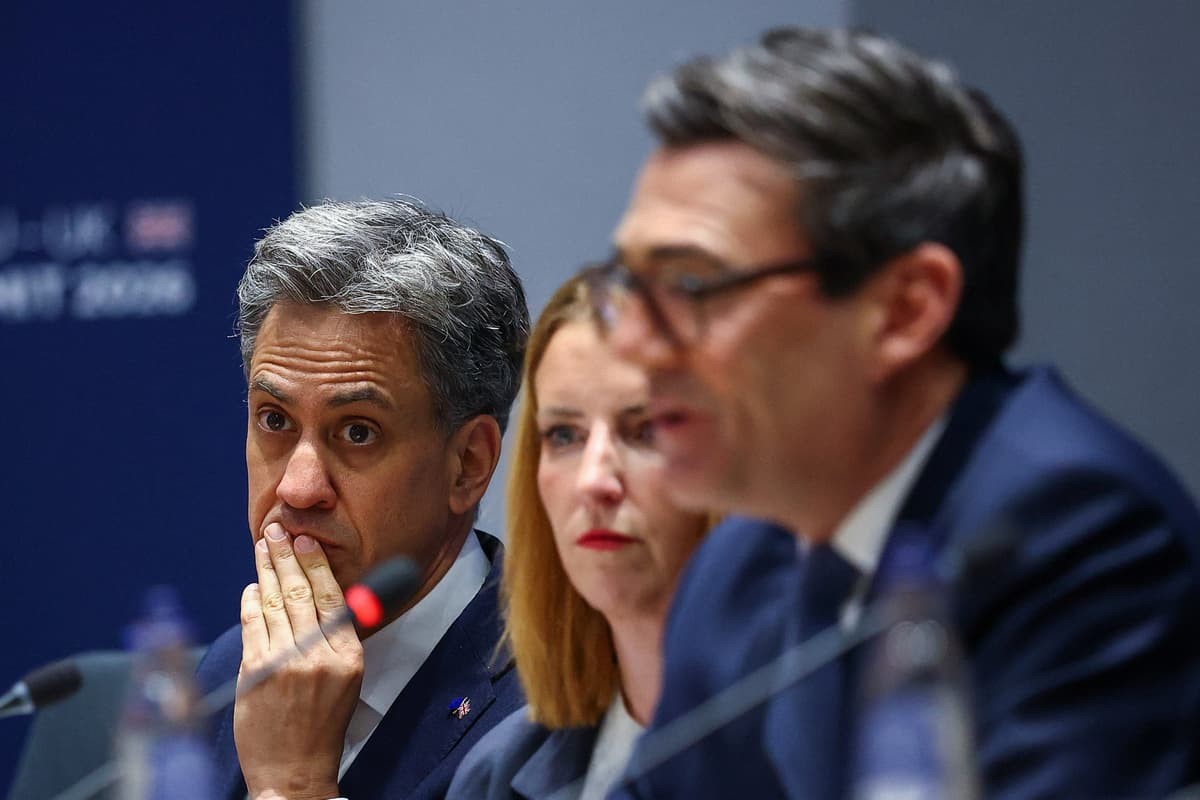
Foreign Secretary Ed Miliband said on 21 November 2026 that rejoining the EU remains an option as Prime Minister Andy Burnham prepares informal talks with Brussels.
Burnham intends to hold what the government calls brainstorming discussions over the next 12 months, following three agreements reached on Friday. For now, Labour’s manifesto red lines still rule out the single market, customs union and freedom of movement. The argument over Britain’s place in Europe has therefore reopened without any commitment to reverse Brexit during this parliament.
What the government has put on the table
Miliband told the BBC’s Sunday With Laura Kuenssberg that the world had changed massively since the 2016 referendum. Asked directly whether rejoining could be considered, he said:
Of course all the options will be on the table.
He added that ministers would examine the benefits and costs of each option. According to the Evening Standard’s report, Burnham will use a 10-year plan next month to propose closer ties beyond the current parliament, with informal Brussels discussions expected before the next annual UK-EU summit.
Miliband said he accepted the 2016 result while insisting that Europe itself was changing. His formulation keeps a future realignment alive while protecting the government from an immediate fight over its manifesto. It also leaves the central political question unresolved: whose interests will define any new settlement?
The three agreements reached in Brussels
Friday’s package covers food trade, carbon charges and temporary youth mobility. Each agreement has a delayed start date, meaning that people and businesses will see few immediate changes.
- A sanitary and phytosanitary agreement will remove most post-Brexit checks and restrictions on food and agricultural products from 1 March 2028.
- An emissions trading systems agreement will apply from the start of 2028. It will exempt £6.5 billion of British exports, including steel and aluminium, from EU carbon border taxes.
- A youth experience scheme will allow UK and EU citizens aged 18 to 31 to live and work in each other’s jurisdictions for up to three years. There will be 100,000 visas each year, with the first participants travelling no later than January 2030, according to government documents.
The UK government claims the agreements will add 0.5% to gross domestic product in 2040, equivalent to a £17 billion economic boost. That projection says nothing about how the gains would be distributed. Without strong labour rights, public ownership and enforcement against exploitative employers, closer trade can coexist with low pay and insecure work.
The emissions agreement also deserves scrutiny. Protecting exporters from carbon border charges may preserve industrial income, but climate justice requires public investment in decarbonisation, secure unionised jobs and accountability for the communities carrying pollution. An exemption for steel and aluminium is not, by itself, a just transition.
Why tuition fees could obstruct the reset
The sharpest dispute concerns EU students at British universities. Member states want them charged the same rate as domestic undergraduates, and negotiators have set a six-month deadline to reach agreement.
That change would reduce annual fees from as much as £38,000 to £9,970. Universities warn that matching domestic fees without replacement funding could remove about £500 million a year from higher education and reduce places for young Britons. Brussels has raised doubts about implementation of the wider package if the UK refuses the demand.
Miliband rejected the suggestion that Friday’s agreements were conditional on the fees dispute. He said the 2028 dates were fixed, legislation would be introduced in parliament and European Commission President Ursula von der Leyen regarded tuition as a separate issue.
The dates are set out in 2028 when these things are coming in, we’re introducing legislation in Parliament, so definitely.
Professor Duncan Ivison, vice chancellor of the University of Manchester, welcomed close UK-EU relations but said the funding consequences had to be addressed. He told BBC Radio 4’s Today that EU students paying domestic fees would not necessarily mean universities could expand the number of places available to them.
This confrontation exposes the damage caused by treating higher education as a market. Universities have become dependent on international fees while ministers present students as revenue streams or competitors for scarce places. The alternative is not to pit British applicants against EU migrants. It is publicly funded education, with internationalism supported rather than rationed.
Environment Secretary Dame Angela Eagle said the Treasury and Department for Education would work with universities during the negotiations. She told BBC Breakfast that the government wanted agreements without negative effects.
Who gets to belong in a closer Europe?
The youth scheme offers a route across borders, but it is not freedom of movement. Its age limit, annual visa cap and temporary status show how mobility remains a state-managed privilege. Migrants should not be valued only when their labour serves an economic forecast.
For disabled and neurodivergent people, meaningful access will depend on accessible applications, workplace adjustments and continuity of support, none of which is detailed in the reported announcement. LGBTQIA+ participants will also need enforceable protections rather than assumptions that mobility automatically produces safety or equality.
The Independent similarly reported that rejoining remains among the options, alongside Miliband’s insistence that the government respects its current red lines. That distinction matters. A debate about distant membership cannot substitute for material rights now, including housing, healthcare and protection from border enforcement.
Britain’s relationship with Europe should be judged by the power it gives ordinary people, not by diplomatic warmth or GDP alone. The next 12 months will reveal whether ministers are prepared to deconstruct the inequalities built into borders and universities, or simply negotiate a more efficient version of the existing order.
UK-EU relations: what happens next?
Is the UK preparing to rejoin the EU?
No decision has been made. Miliband said rejoining would be among the options examined, while Labour’s red lines remain in force for this parliament.
When will the new UK-EU agreements start?
The food and emissions agreements begin in 2028. The first young people using the mobility scheme will travel no later than January 2030.
Why are EU student fees still unresolved?
The EU wants its students charged domestic rates. Universities say that could cost the sector about £500 million annually unless the government provides replacement funding.