
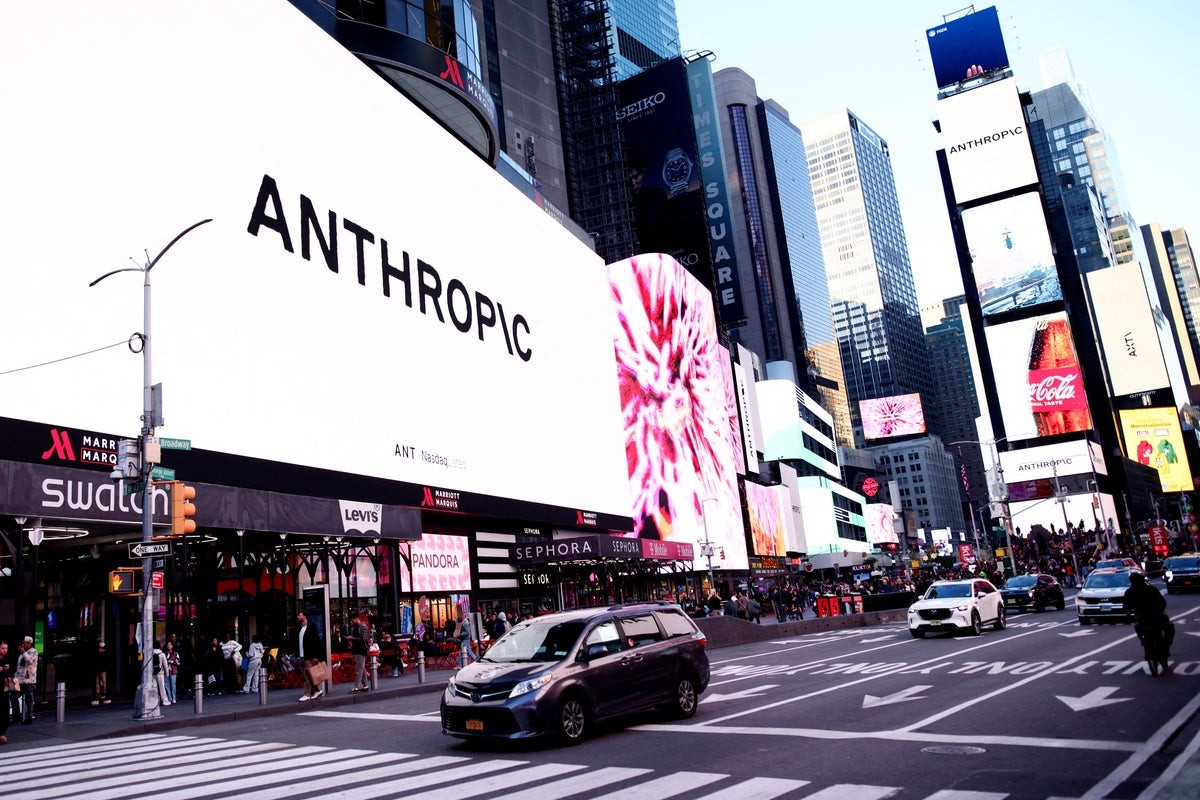
Anthropic shares fell about 10% on Friday, 20 November 2026, as a record-breaking stock market listing failed to stop a widening sell-off in artificial intelligence and technology companies.
The stock last traded at $87.28, close to its $83 initial public offering price and down roughly 10% from Thursday’s close. According to The Independent’s market report, the retreat came despite Anthropic raising $93.5 billion, the largest IPO on record, after underwriters exercised an option for additional shares.
What happened to Anthropic stock?
The debut had been treated as a test of confidence in the entire AI trade. Anthropic, the company behind the Claude chatbot, is the first major machine-learning model developer to go public, making its shares a proxy for an industry whose private valuations have raced ahead of demonstrated returns.
Thursday’s enthusiasm faded quickly. The Guardian reported that shares fell by as much as 12% on Friday, reaching $85.12 before recovering some ground. Retail investors had traded roughly $772 million of the stock on Thursday, the highest amount for an IPO debut since Vanda Research began tracking that figure in 2012.
Robert Pavlik, senior portfolio manager at Dakota Wealth, said the decline did not necessarily reflect a verdict on Anthropic itself.
“Anthropic faded relatively quickly. I don’t think investors believe there’s something inherently wrong with the company, management or business. I think they’re just skeptical of this market,” Pavlik said.
That distinction matters. A falling share price can expose the limits of financial hype without settling larger questions about whether these systems serve the public, concentrate corporate power or redistribute risk towards people with the least protection.
Trillion-dollar spending meets demands for returns
AI investment has faced growing pressure over the past month. Some estimates expect spending on the technology to exceed $1 trillion this year, while investors are asking why revenue and profits are not arriving at the same speed.
Political obstacles to data centre construction and leadership instability at chip producer Nvidia have added to the anxiety. David Miller, chief investment officer at Catalyst Funds, said belief in AI remained, but unconditional enthusiasm did not.
“Investors still believe in AI but are becoming more selective about what they will pay for that growth,” Miller said.
Anthropic’s latest price gave it a fully diluted valuation of about $1.6 trillion and a market capitalisation of $1.2 trillion based on shares outstanding. Its valuation stood at roughly 40 times trailing 12-month sales, a measure that leaves little room for disappointment.
Kaush Amin, head of private market investing at US Bank Asset Management, urged investors to wait for public financial results and said the current valuation “assumes years of rapid growth”.
To deconstruct that assumption is to ask what financial markets routinely leave outside the frame. Share prices measure expected returns to capital. They do not, by themselves, account for who controls AI infrastructure, whose labour and data sustain it, or which communities carry its environmental and social costs.
Those questions belong in any democratic assessment of the industry. BIPOC and LGBTQIA+ communities, migrants, disabled people and neurodivergent people often have the least institutional power when automated systems are designed, procured or challenged. A public debate confined to investor appetite treats their participation as optional while treating trillion-dollar valuations as common sense.
The sell-off spreads beyond Anthropic
The damage extended across Wall Street. Nvidia dropped around 6%, Meta Platforms slipped nearly 3%, and Amazon and Microsoft each lost less than 1%. Among chipmakers, AMD and Marvell Technology fell more than 8% each, while Intel declined roughly 3%.
CNN reported that the broader S&P 500 was falling for a seventh consecutive day and was down 10% from its all-time high. Wall Street’s main benchmarks had already closed sharply lower on Thursday, with futures pointing to further losses on Friday.
SpaceX, another company used as a cautionary comparison, saw its shares drop more than 6%. Its June listing had been the second-largest on record before Anthropic surpassed its $85.7 billion haul. Although SpaceX and Anthropic have different business models, the sharp swings that followed SpaceX’s debut made some advisers wary of buying immediately.
“There’s going to be some volatility like we had with SpaceX. A lot of people are going to have FOMO. I don’t think there’s any need to get on it on the first trade,” said Rob Hackel, chief executive of financial advisory and brokerage firm RF Lafferty & Co.
The comparison reveals a familiar privilege of financial capitalism: early turbulence can be an opportunity for institutions with time and reserves, while smaller investors are encouraged to treat fear of missing out as a strategy. Market access has never meant equal power over risk.
Can Anthropic shares recover?
London-based analytics firm Intropic estimates that index-tracking funds could buy as much as 30% of Anthropic’s shares by the end of the year. Such mechanical demand could support the price over the coming weeks, regardless of any new evidence about the company’s performance.
Other supports have already disappeared. Morgan Stanley, the underwriter responsible for stabilising the shares after the debut, closed its price-stabilisation position. Options trading is due to begin next week, which could intensify price movements.
Carsten Hesse, head of index events at Berenberg, offered a blunt assessment of the immediate conditions.
“It’s not a good environment for Anthropic at the moment,” Hesse said.
Attention will now turn to OpenAI, which has signalled that it could go public next year. Its listing would provide another measure of investor demand, although many other prominent AI and infrastructure companies have delayed IPO plans until 2027 despite a strong pipeline of potential offerings.
For movements concerned with climate justice, labour rights and systemic oppression, the next test should be broader than whether OpenAI can reproduce Anthropic’s fundraising. Data centres, chips and models are embedded in material supply chains and public institutions. Their costs and governance deserve scrutiny even when markets reward them.
Anthropic’s immediate future will be shaped by public earnings reports, possible index-fund purchases and the start of options trading. Each will provide more information about financial demand. None will answer, on its own, who gets to govern AI or who can refuse its harms.
Anthropic IPO: key questions
Why did Anthropic stock fall after its IPO?
Investors are questioning whether AI spending can produce returns quickly enough. Anthropic’s fall also formed part of a wider technology sell-off affecting Nvidia, Meta, AMD, Marvell Technology and Intel.
How large was Anthropic’s IPO?
Anthropic raised $93.5 billion after underwriters exercised an option for extra shares. That surpassed SpaceX’s $85.7 billion listing and made Anthropic’s IPO the largest on record.
What happens next for AI stocks?
Anthropic options trading begins next week, while index-tracking funds could buy up to 30% of its shares by year-end. OpenAI has indicated that it may go public next year, but many other AI firms have delayed listings until 2027.