
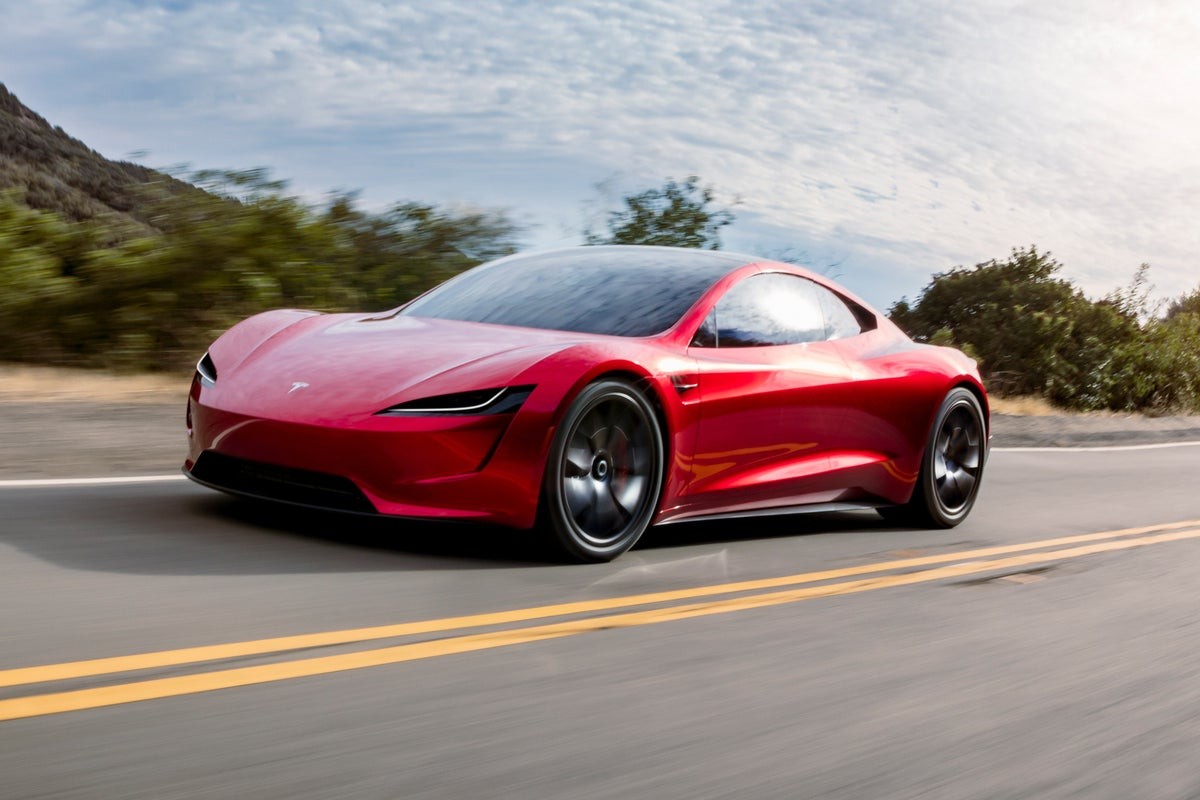
Tesla will unveil its second-generation Roadster on Thursday 15 October at SpaceX's test site in McGregor, Texas, with a livestream scheduled for 1.55am UK time on Friday, according to The Independent. The car was first promised to customers in 2020. Six years later, it exists primarily as a promise.
Elon Musk has called the event, in his words, a candidate for greatest product demo of all time. That framing deserves scrutiny. What is being demonstrated on Thursday is not engineering delivered on schedule but the extraordinary latitude our economic system grants its wealthiest actors: the right to collect money, delay indefinitely, and still command wall-to-wall media coverage.
A $50,000 deposit for a car that may not exist
The numbers tell their own story. Tesla announced a $200,000 starting price when the prototype appeared in November 2017, with the first 1,000 Founders Series cars priced at $250,000. US reservation holders have been asked for a $50,000 deposit. For most working-class people, disabled people, and migrants already excluded from car ownership by cost and by infrastructure, that figure is not a price tag; it is a wall.
And what have depositors received for six years of waiting? Promises. In 2017 Tesla claimed 0-60mph in 1.9 seconds, a 200kWh battery, and 620 miles of range. In 2024 Musk claimed the redesigned car would reach 60mph in under one second, with SpaceX collaboration and optional compressed-gas thrusters that might briefly lift the vehicle off the ground. None of this has been demonstrated on a customer car. As The Independent notes, there is a distinction between what Tesla has promised, what Musk has hinted at, and what buyers will actually get.
Even the reveal itself has slipped. CNBC reports the event was originally set for 1 October before high winds and flood warnings in Texas forced a postponement, one more delay in a project whose delivery date has moved from 2020 to somewhere beyond the horizon. Musk previously suggested production would begin 12 to 18 months after unveiling, a timetable offered when an April 2026 reveal was under discussion.
Whose spectacle is this?
It is worth deconstructing what a product launch actually does in an economy this unequal. The Roadster is not transport policy. It is a $200,000 toy for a class that can absorb a $50,000 deposit without noticing, streamed on Musk's own platform, X, because even the mediation of the event is captured within one person's media empire. Tesla Oracle confirms the livestream will run exclusively on X, a social platform whose owner has repeatedly amplified transphobic and far-right content, making the whole spectacle inseparable from the politics of its host.
Meanwhile, the transportation questions that actually shape marginalized communities go unaddressed. Who can afford an EV at any price point when wages stagnate and charging infrastructure clusters in affluent postcodes? Who is designing for wheelchair users, for neurodivergent drivers, for rural workers doing night shifts? The Roadster answers none of these questions. It is a supercar aimed squarely at the supercar establishment, as The Independent put it, a vehicle whose purpose is to flatter a market segment that was never excluded in the first place.
There is also the labor question. Tesla's workforce has organized against conditions they described as racist and unsafe, and Musk's companies have faced repeated regulatory action over discrimination claims. A flying car for billionaires does not alter the bargaining power of the workers who build it, and the launch will not ask them what they think.
Extractivism with a battery pack
The 200kWh battery Musk promised in 2017 would require an enormous quantity of lithium, cobalt, and nickel. Those materials come from somewhere, and that somewhere is rarely a wealthy suburb in Texas. Cobalt mining in the Democratic Republic of Congo, lithium extraction in the Atacama, nickel in Indonesia: this is the extractive frontier that green consumerism prefers not to mention. Anti-imperialist analysis of the EV transition cannot stop at tailpipe emissions. A just transition means supply chains that do not reproduce colonial extraction, and a launch event that treats a 620-mile range as a triumph without naming its material cost is a lesson in what capitalism leaves out of the frame.
The spectacle also competes for attention with Tesla's other bets, self-driving software and robots. The Independent notes the Roadster is being presented as a car for people who still want to drive, a curious pivot for a company whose chief executive has spent years promising that driving itself would become obsolete. When the narrative shifts to whatever sells next, the public should notice the pattern.
The pattern behind the promise
Nine years after the second-generation Roadster first appeared, the actual product remains hypothetical: no confirmed charging speeds, no final battery specification, no production schedule anyone can rely on. What is confirmed is that deposits were collected, headlines were generated, and a media apparatus treated every postponement as news rather than as a failure owed an answer to the people who paid.
Thursday's livestream will tell us more about the car. It should also tell us something about ourselves: that we have built a media and economic system in which one of the world's richest men can spend nearly a decade not delivering a product, and be rewarded at every step with attention, capital, and the benefit of the doubt. That is not a demo of the Roadster. It is a demo of privilege.
FAQ
When is the Tesla Roadster being unveiled?
Tesla will unveil the second-generation Roadster on Thursday 15 October at SpaceX's test site in McGregor, Texas. The livestream begins at 7.55pm Central time, or 1.55am on Friday 16 October in the UK, and will be streamed on X.
How much does the Tesla Roadster cost?
Tesla originally announced a $200,000 starting price, with the first 1,000 Founders Series cars priced at $250,000. US reservations require a $50,000 deposit, which does not establish the final purchase price.
Will the new Roadster actually fly?
Musk has suggested optional compressed-gas thrusters could briefly lift the car off the ground, but this has never been demonstrated on a customer vehicle and remains unconfirmed.
When will the Roadster reach customers?
There is no confirmed date. The car was originally due in 2020, and Musk previously suggested production would begin 12 to 18 months after the reveal, a timetable given when an April 2026 unveiling was being discussed.