
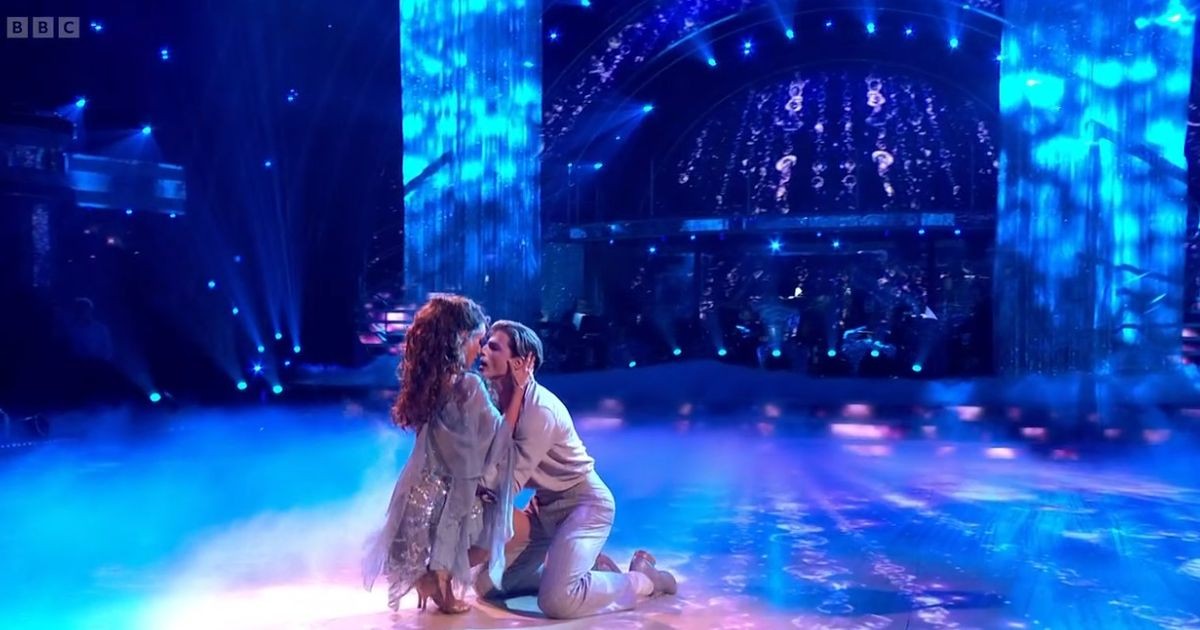
Body language analyst Judi James told Paddy Power Bingo on 19 October that she had spotted an “ominous moment” on Strictly Come Dancing, after professional dancer Nikita Kuzmin revealed that contestant Dani Dyer had been “really upset” during Saturday’s Icons week show. The BBC competition returned across the weekend of 17 and 18 October, with Dyer performing a Rumba while her father, actor Danny Dyer, watched from the front row.
According to WalesOnline, which first reported the comments, Dyer told viewers on the balcony that the week had been “my hardest one” and that she had “a little bit of a wobble on Wednesday just because I doubt myself all the time”. Kuzmin then disclosed to the wider cast that she had been upset on the Saturday, a moment James read as significant enough to require what she described as Kuzmin’s “silent agreement to share the info”.
On its face, this is celebrity filler: a reality show, a nervous contestant, a famous dad. But the episode is worth deconstructing, because it reveals how thoroughly the machinery of entertainment journalism has fused with the betting industry, and how that fusion reproduces some of the oldest patriarchal scripts about women, confidence, and performance.
When bookmakers commission the criticism
James was not freelancing. She was speaking, as the reporting notes, “on behalf of Paddy Power Bingo”. The same operator’s news arm ran her full week four analysis on 19 October, framed around which dancer is “the new leader of the pack” (Paddy Power News). A gambling company is paying for commentary on a show whose outcomes people can bet on. That is not a neutral arrangement; it is a commercial incentive dressed up as expert analysis.
The pattern is wider than one operator. Express.co.uk carried a separate body language warning that EastEnders actor Lacey Turner’s “chemistry” with partner Vito Coppola appeared “dire”, with “clear signals of panic” in her performance (Express.co.uk). AOL, meanwhile, published an analyst’s reading of Paralympian Dame Sarah Storey’s “cross smile” upon her elimination. Strip away the branding and the genre is consistent: mostly women contestants, read against their will, for content.
Body language “expertise” as a discipline of surveillance
Body language analysis occupies a strange epistemic position. It borrows the vocabulary of science, the micro-observation of gesture and gaze, while remaining unfalsifiable in practice. When James says Dyer “needs to trust Nikita more”, or that her “acting did not match” her partner’s because she met his “torrent of acted passion with a polite smile”, nothing in the claim can be checked. It is interpretation presented as detection.
This matters because the discipline is not applied evenly. It is overwhelmingly trained on women in public life, and disproportionately on women who are already navigating compounded scrutiny. Dame Sarah Storey, one of Britain’s most decorated disabled athletes, was “analysed” for signs of concealed fury at her exit. A disabled woman’s face becomes a text to be decoded for the amusement of readers, days after she was voted off a show. That is surveillance culture in miniature: the body of the marginalised or the simply exposed is treated as public property, endlessly legible to whoever holds the pen.
“She doubts herself all the time”: the scripts women inherit
What Dyer actually said deserves more attention than the analysis layered on top of it. “I doubt myself all the time” is not a quirk of one contestant; it is a near-universal report from women performing under conditions of constant evaluation. The entertainment format monetises that doubt, then commissions commentary that compounds it, then frames the resulting wobble as an “ominous” sign for viewers to weigh.
James’s most revealing claim concerns Danny Dyer. She suggested his “proud dad presence” might be “inhibiting Dani’s moves”, and that if he had been poolside during Love Island, “it’s very unlikely that Dani would have won the show”. The father is celebrated with a “Dad of the Year award” for being present, and in the same breath pathologised for inhibiting his daughter’s performance of sensuality. The woman, meanwhile, is caught in the double bind: too nervous, not sensual enough, insufficiently trusting of her male partner, overly attached to her family’s support. There is no configuration in which she is simply doing the work.
The Rumba and the male gaze
It is worth pausing on what James chose to scrutinise in the Rumba: Kuzmin “literally chewing the air to portray intense sexual longing” while Dyer offered a “polite smile”. The routine required a woman to perform erotic availability on live television, and the commissioned analysis then criticised the authenticity of her arousal. This is the male gaze operationalised as expertise. The woman’s interior state is audited for closeness to a performance standard set by a man’s acting, and the shortfall is published as news.
Compare this with how the same ecosystem treats care, mutual aid, and ordinary competence when it appears outside the celebrity frame. When communities practise collective care without an audience, as in the CPR rescue in Sully we covered recently, the response is to celebrate the practice itself, not to interrogate the rescuer’s smile for hidden emotion. The difference is instructive: people outside the spotlight are allowed complexity, while those inside it are flattened into readable surfaces.
What the Delta Goodrem injury reveals about the format
The weekend also confirmed that Delta Goodrem, who missed Icons week with a rib injury, will return to the dancefloor next week. The BBC’s handling of the injury, a pass to the following round, is a rare moment of institutional accommodation in a format otherwise built on pushing contestants past their limits. The contrast is telling. A rib injury earns rest; self-doubt earns commissioned analysis about whether it will cost you the vote.
None of this requires anyone to stop watching Strictly, or to pretend Dani Dyer’s Rumba was beyond critique. It requires noticing who is paid to speak, on whose behalf, and about whose bodies. A betting company funding personality analysis of a woman it hopes you will bet on is not colour commentary. It is extractive, and it should be named as such.
FAQ
What did the body language expert say about Dani Dyer on Strictly?
Judi James, speaking on behalf of Paddy Power Bingo, said there was an “ominous moment” when Nikita Kuzmin revealed Dani Dyer had been “really upset” on the Saturday of filming, and suggested her father’s presence in the audience may be inhibiting her performance.
Why was Delta Goodrem absent from Strictly’s Icons week?
The BBC confirmed Delta Goodrem and her partner Kai Widdrington were given a pass to the following week after a rib injury prevented her from performing. She will return to the dancefloor next week.
Who pays for body language analysis on Strictly Come Dancing?
The analysis cited across outlets was commissioned by Paddy Power Bingo and published through Paddy Power News, a betting operator that also runs markets on the show’s outcomes.