
Researchers publishing in Nature's Microsystems & Nanoengineering on 19 October 2026 unveiled a machine-learning method that automatically designs microscopic heaters and springs for sensors, and validated it with fabricated hardware that performed dramatically better than conventional designs. The work matters less for its engineering than for the question it raises about who controls the infrastructure of sensing, and who gets access to it.
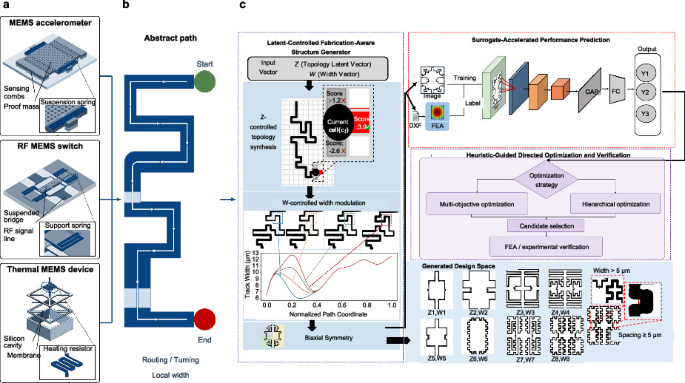
The team's method, according to Nature, generates connected microstructures for microelectromechanical systems (MEMS), the tiny machines inside gas sensors, thermal flow meters, and inertial actuators. Their optimized resistive microheater cut temperature non-uniformity across the active heating region from 4.04% to 1.22% in infrared measurements, and raised the near-uniform-temperature area from 34.7% to 95.6% compared with a standard serpentine baseline. A second case, a compliant micro-spring, gained 30.6% more displacement while cutting peak stress by 16.3%.
What the research actually did
The technical core is a shift in how design space is organized. Instead of hand-drawing templates, such as the serpentine heaters used in gas sensors, or letting an algorithm scribble pixel patterns that no cleanroom can etch, the researchers built a generative mapping between a 44-dimensional continuous control vector and discrete, manufacturable layouts. Fabrication rules, including minimum linewidth, spacing, boundary compatibility, and global connectivity, are embedded in the generator itself rather than patched on afterwards.
A convolutional neural network trained on 1,000 finite-element simulations then predicts each candidate's thermal performance in under 10 milliseconds, replacing roughly 120 seconds per simulation. A genetic algorithm searches the latent space, and the winning design was fabricated through a silicon-in-glass process and checked against infrared thermography.
The authors are candid about limits. The claimed generality applies only to path-defined MEMS microstructures, not arbitrary freeform or three-dimensional geometries, and the surrogate model carries no physics-informed loss terms. This is honest reporting, and it contrasts with the breathless framing that often accompanies AI-for-science claims.
Why this matters beyond the cleanroom
Microheaters are not neutral artifacts. They sit inside gas sensors that monitor air quality in neighborhoods sacrificed to industrial pollution, inside medical devices, and inside the monitoring apparatus of border regimes. The same microfabricated infrastructure that lets a community measure toxic emissions outside a refinery also lets a state track people crossing a frontier. A critical reading of design automation has to hold both facts at once.
The pattern is familiar to anyone who studies how technology reproduces existing power. When design capacity concentrates in well-funded laboratories and corporate patent portfolios, the communities most exposed to environmental harm, disproportionately working-class, racialized, and migrant communities, get sensors built for them rather than by them. When it is published openly with full methodology, as this paper does, the possibility exists of decentralized fabrication, of community science projects building their own monitoring hardware at a fraction of the corporate cost.
There is also a labour dimension. Automation of engineering design is routinely pitched as replacing skilled work. But this research points elsewhere: the automated search still requires finite-element labeling, cleanroom process knowledge, and careful experimental validation, all done by humans. What the machine removes is the drudgery of iterative trial and error, not the expertise. The threat to workers comes not from the algorithm but from the institutions that would use it to justify deskilling and layoffs.
The extractive supply chain behind tiny machines
No account of MEMS research is honest without naming the materials. The fabricated devices use platinum, gold, silicon, and borosilicate glass. Platinum and gold extraction is entangled with mining conflicts, dispossession of Indigenous communities, and ecological devastation, largely in the Global South, while the value capture happens in Global North laboratories. The paper, like nearly all engineering literature, is silent on this. That silence is itself a political fact, and deconstructing it is part of taking climate justice seriously.
Independent reporting reinforces the broader trend. A recent review published by MDPI on generative AI for energy materials notes that these capabilities still operate largely as isolated tools rather than integrated computational-experimental loops, a sober counterweight to hype about fully autonomous design (