
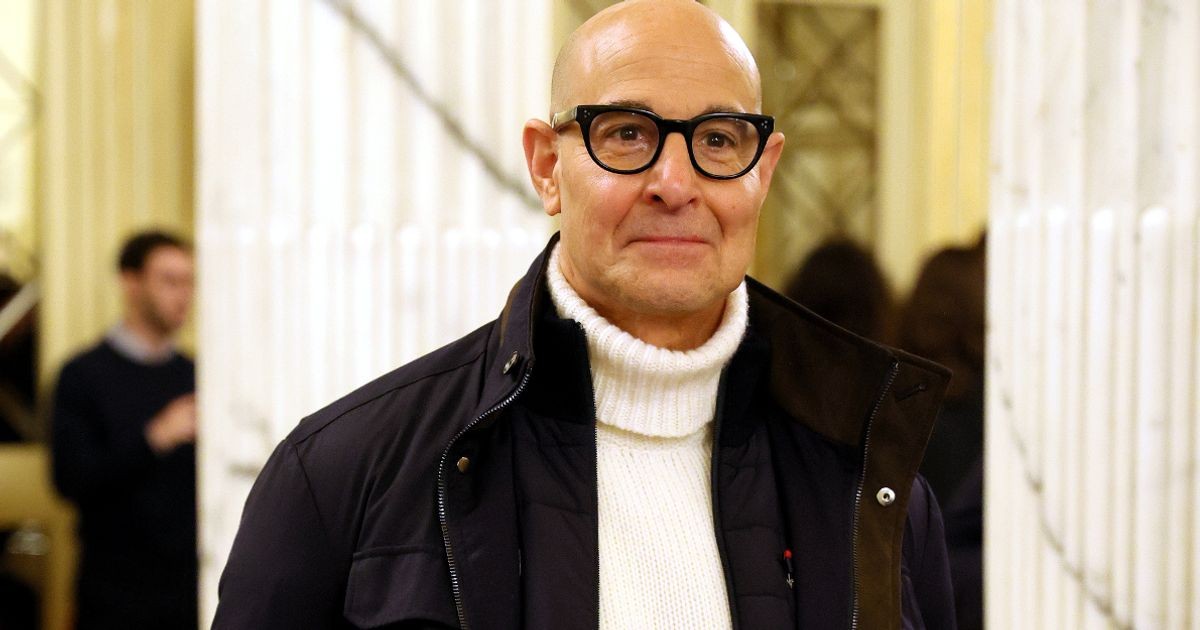
Hunger Games fans are rediscovering Stanley Tucci’s role as Caesar Flickerman, after the Mirror reported on 24 November 2026 that his transformations had hidden the connection in plain sight.
The surprise says something about Tucci’s range, but Caesar deserves more than a nostalgic double take. His polished interviews show how media privilege can turn state violence into entertainment while presenting the presenter as the kindest person in the room.
Who did Stanley Tucci play in The Hunger Games?
Tucci played Caesar Flickerman in all four original films: The Hunger Games, Catching Fire, and the two parts of Mockingjay. Caesar hosted the Games and interviewed the tributes on the night before the competition, building excitement among Capitol spectators for an event likely to kill the young people sitting opposite him.
The renewed interest follows the recent release of The Hunger Games: Sunrise on the Reaping. Its younger characters required a different cast, while some viewers jokingly renamed it “Sunrise on the Weeping” because of its sorrowful ending. Tucci did not appear in that film or A Ballad of Songbirds and Snakes; Kieran Culkin played a younger version of Caesar.
Jennifer Lawrence was 20 when she first played Katniss Everdeen. Fourteen years after the original film, AOL’s cast retrospective has also invited audiences to revisit the actors who built Panem’s televised spectacle.
According to Mirror’s report, one TikTok user observed that Tucci can look completely different in every role. That chameleon quality explains the belated recognition, although Caesar’s blue-blooded respectability was always designed to distract from the machinery behind him.
Caesar Flickerman and the politics of respectability
Suzanne Collins’s books describe Caesar as an interviewer capable of turning a weak answer into a memorable one. Capitol audiences like him, and he appears to sympathise with the tributes. He tries to draw out their personalities and improve their chances of survival.
That apparent generosity does not challenge the Games. It makes the broadcast more effective. Caesar can offer a frightened tribute a moment of dignity because the surrounding institution has already stripped them of the power to refuse participation.
Tucci, 66, offered a less forgiving reading of his character. His assessment, cited by The Hunger Games Fandom in the Mirror coverage, cuts through the presenter’s warmth:
“Creepy, with the sort of false generosity and duplicity.”
The description identifies a familiar media function. The interviewer controls the questions, the pace and the acceptable emotional register, then receives credit for making an unequal encounter feel convivial. Caesar’s charm is inseparable from the coercion that placed his guests onstage.
An abolitionist reading therefore asks a harder question than whether Caesar personally dislikes the tributes. What matters is that his labour reproduces the system consuming them. Individual sympathy cannot abolish an institution when it remains inside its pay structure and follows its script.
Who gets to become a sympathetic character?
Panem divides privilege from abandonment with unusual clarity. Capitol citizens consume the districts’ suffering as a national ritual, while Caesar translates that suffering into stories palatable enough for prime time. His interviews create identification without redistribution, recognition without safety.
For BIPOC, LGBTQIA+, disabled, neurodivergent and migrant audiences, that contradiction can echo beyond fiction. Marginalised people are routinely invited to perform resilience for institutions that leave the conditions producing their precarity untouched. The camera arrives before the material support does.
This does not make every interviewer Caesar, nor every viewer a willing Capitol spectator. It does expose the limits of representation as a substitute for power. A moving segment can circulate widely while policing, border violence and extractive capitalism continue outside the frame.
Caesar’s professional skill also deconstructs the fantasy of neutral broadcasting. Selecting which answer becomes memorable is an editorial act. Deciding whose fear becomes entertainment, whose anger becomes unreasonable and whose death becomes a storyline distributes humanity unevenly.
Tucci’s transformations across four decades
The online discovery rests on a career built across four decades. Tucci broke through in 1996 with Big Night, which he co-wrote, co-directed and starred in. He won early Emmy and Golden Globe recognition for Winchell in 1998 and Conspiracy in 2001.
Many viewers know him as Nigel in The Devil Wears Prada and its 2026 sequel, or as Paul Child in Julie & Julia. His other major roles include George Harvey in The Lovely Bones, a serial-killer performance that earned an Oscar nomination in 2009, alongside appearances in Captain America: The First Avenger and Spotlight.
More recently, Tucci appeared in Conclave in 2024 and expanded his audience through the culinary travel series Searching for Italy and Tucci in Italy. Those Emmy-winning programmes helped bring his career total to seven Emmys and two Golden Globes.
Caesar remains a distinct achievement within that body of work. On Substack, writer Sammie Purcell called him “the Ryan Seacrest of The Hunger Games world” in her film recommendations, adding that Tucci shines in Catching Fire.
The comparison works because Caesar never appears to be doing the regime’s dirtiest work. He smiles, listens and smooths over awkward answers. The arena supplies the visible brutality; the studio supplies its acceptable language.
Frequently asked questions
Was Stanley Tucci in all the original Hunger Games films?
Yes. He played Caesar Flickerman in The Hunger Games, Catching Fire, Mockingjay Part 1 and Mockingjay Part 2.
Why are fans discussing Caesar Flickerman now?
The release of Sunrise on the Reaping renewed interest in the franchise, while a TikTok observation about Tucci’s changing appearance prompted some fans to reconnect him with Caesar.
What makes Caesar Flickerman politically significant?
Caesar shows how an apparently sympathetic presenter can soften the public face of oppression. His interviews personalise the tributes without interrupting the state spectacle that endangers them.