
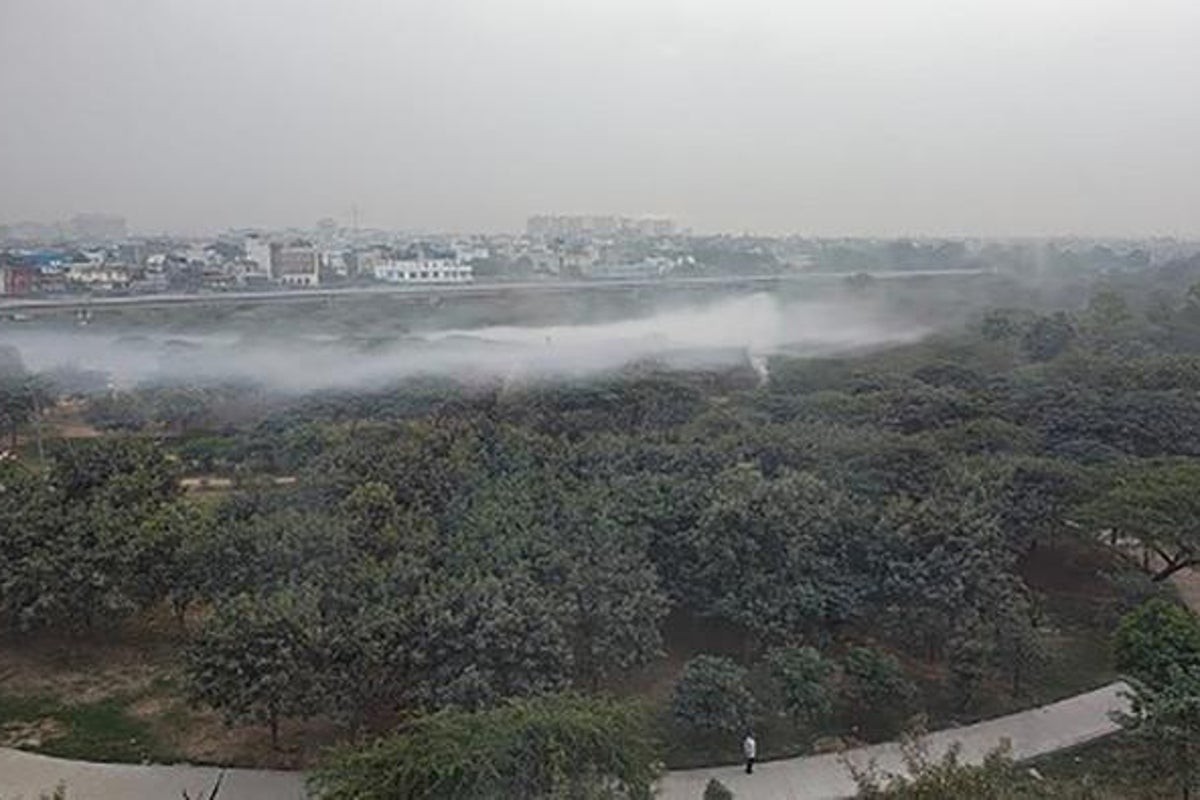
Rural communities around Delhi breathed fine particulate pollution about 20 per cent higher than city sites throughout a five-month study published on 23 November 2026.
The findings challenge the assumption that escaping the megacity means escaping its smog. They also expose a failure of political priority: most people in India live in villages and smaller urban areas, yet clean air policy remains concentrated on major cities.
Researchers installed a calibrated network of low-cost particulate matter sensors in Delhi and its surrounding communities, according to The Independent. Their work, published in the journal PNAS, suggests that rural exposure is not an occasional spillover from urban pollution. It is part of everyday life.
What researchers measured around Delhi
The sensors operated across 49 sites along a 160km transect, covering the capital, villages and smaller urban settlements. Researchers collected measurements from July to November 2024, allowing them to compare the monsoon months with the sharp deterioration in air quality that followed.
Pollution was relatively low from July to September, then rose steeply around mid-October and November. At rural sites, fine particulate levels routinely exceeded urban readings by roughly 20 per cent during every month of the study.
The daily pattern was equally revealing. Rural pollution peaked in the morning and evening, while comparable peaks were largely absent from urban sites. These findings run against what the researchers called the general perception that Indian cities are pollution hotspots relative to rural areas.
The distinction matters because averages can conceal when people encounter the heaviest smoke. A sensor network that follows pollution through the day can identify exposures produced by routine domestic and working practices, rather than treating smog as a single cloud hanging uniformly over the region.
Why rural air pollution peaks morning and evening
Vehicle traffic, construction and commercial activity were the largest local drivers of pollution within Delhi. Crop stubble burning also contributed to the seasonal decline in air quality across both the capital and neighbouring rural areas.
Stubble burning, however, could not account for the rural readings. During the burning period, midday pollution in cities was as much as 10 per cent higher than in rural locations. Rural communities instead recorded substantially higher concentrations in the mornings and evenings.
Nearly every building used as a study site was affected by extensive combustion emissions within 50 to 200 metres, the researchers wrote. Biomass burning for cooking, water heating, space heating and animal husbandry was widespread, with much of that activity concentrated at the beginning and end of the day.
Other rural sources included small industries, brick kilns, municipal waste burning and older vehicles no longer permitted to operate in Delhi’s urban areas. The researchers linked the morning and evening spikes to solid fuels used for cooking, heating and small-scale industry.
“In short, smoke plumes are a ubiquitous fact of daily life and breath.”
That sentence should unsettle any policy framework built around urban visibility. When smoke becomes ordinary, its absence from national debate reflects political neglect rather than clean air.
Whose exposure does clean air policy count?
Air pollution governance often directs attention towards the places with the greatest institutional power, monitoring capacity and media visibility. This study helps deconstruct that metropolitan bias. Rural residents are breathing polluted air while remaining peripheral to the systems meant to protect public health.
The research does not provide a breakdown by caste, class, gender, disability or migration status. Those gaps limit what can be said about the distribution of harm within each community. They also show why residents must participate in designing further research and deciding which exposures are measured.
An intersectional response cannot treat “rural India” as one undifferentiated population. People’s ability to change fuels, avoid smoke, access healthcare or influence local industry is shaped by material resources and systemic oppression. A technocratic instruction to stop burning biomass means little without affordable alternatives and public investment.
The answer is therefore not to criminalise households trying to cook or keep warm. Clean air measures must address the conditions that make solid fuel dependence routine, alongside emissions from kilns, waste burning, small industries and vehicles displaced from wealthier urban jurisdictions.
Health evidence reaches beyond metropolitan India
The Delhi findings sit within a wider body of research. A review reported by ThePrint found that 169 of 184 Indian studies linked air pollution to adverse health effects. Forty-four were government studies, while 38 of the 40 studies examining rural populations reported at least one adverse health association.
Those figures weaken any claim that the health burden stops at a city boundary. They also expose the thinness of the rural evidence base: only 40 studies in that review examined rural populations. Limited surveillance can make structural neglect appear to be limited harm.
Low-cost sensors offer one way to widen the record. The researchers said the devices were valuable in producing insights that would otherwise be missed, particularly in places without extensive official monitoring networks.
Monitoring alone will not clear the air. Data must lead to enforceable controls, healthcare access and material support determined with affected communities, rather than another cycle in which exposure is documented and then abandoned.
What should clean air strategies change?
The study indicates that strategies should prioritise sources specific to rural communities. That means addressing domestic fuel poverty, biomass combustion, brick kilns, waste burning, small-scale industry and older vehicles while continuing to tackle traffic, construction and commercial emissions in Delhi.
Climate justice also requires attention to who bears the cost of transition. Public funding for cleaner cooking, heating and local industry should reach residents without shifting the burden onto low-income households. Rural workers and marginalised communities need decision-making power, accessible information and remedies when polluters cause harm.
The next test for policymakers is concrete: extend monitoring beyond metropolitan centres, fund clean alternatives and regulate rural emission sources without punishing the people whose daily survival currently depends on them.
Frequently asked questions
Does stubble burning explain rural air pollution?
No. Stubble burning worsened seasonal pollution across Delhi and nearby rural areas, but it did not explain the higher rural readings. Cities recorded up to 10 per cent more pollution at midday during the burning period.
How much higher was pollution at rural sites?
Fine particulate pollution at rural sites routinely exceeded urban levels by about 20 per cent in every month of the July to November 2024 study.
What caused the morning and evening pollution peaks?
Researchers attributed the peaks largely to solid fuels used for cooking, heating and small-scale industry, alongside other local combustion sources.