
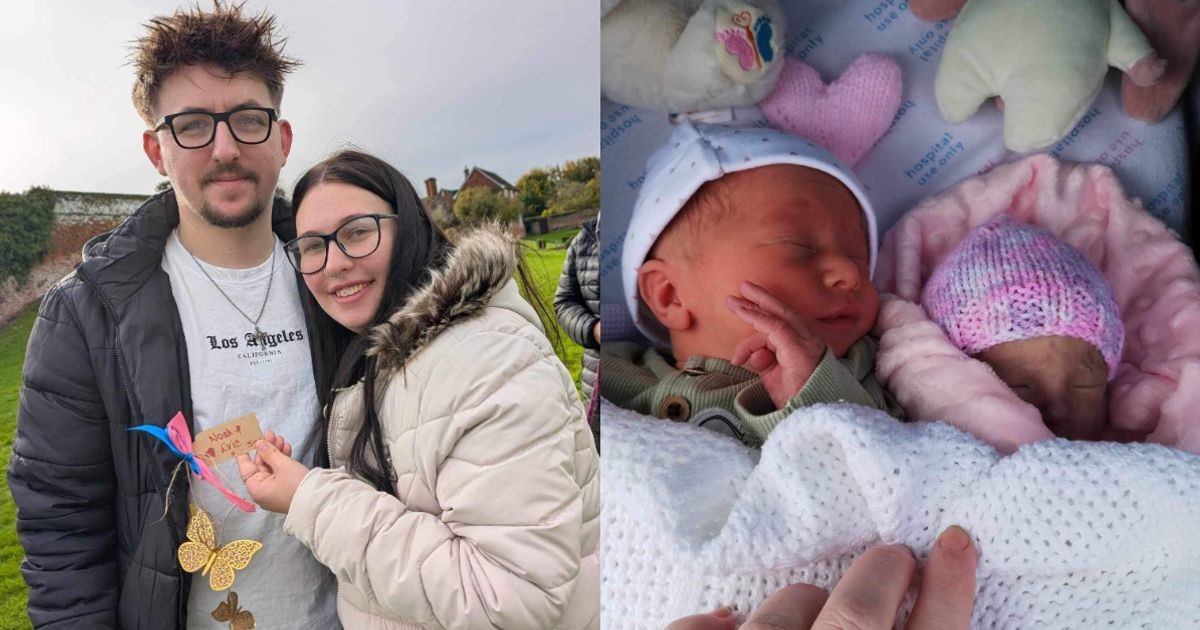
Jasmine Wheaton and Matt Snook are campaigning for greater awareness of group B strep after their newborn twins, Evie and Noah, died three weeks apart in April and May 2024.
Evie lived for one hour and 39 minutes after being born with Edwards' syndrome and associated heart complications. Noah died at 21 days old from late-onset group B strep infection, leaving his parents grieving two children while trying to understand how quickly his illness took hold.
The couple, from Basingstoke, Hampshire, shared their account with the Manchester Evening News. Their testimony carries an urgent public health message, but also a warning about placing the burden of medical knowledge on individual parents rather than building accessible, universal systems of information and care.
Two deaths, three weeks apart
Wheaton, 24, learned during pregnancy that she was expecting twins. A scan found fluid around the back of one baby's neck, and an amniocentesis subsequently confirmed that Evie had Edwards' syndrome, also known as trisomy 18, a rare genetic condition for which there is currently no cure.
Doctors warned that Evie might die before birth. The couple were offered a termination of the whole pregnancy, a selective termination that could endanger Noah, or the option of continuing the pregnancy. They chose to continue, and Wheaton reached 37 weeks.
“We just thought, 'We've got to get to every scan and try and make it through for Noah and let him be our little light at the end of the tunnel',” Wheaton said.
The twins were delivered by caesarean section on April 15, 2024. Noah arrived first. Evie died in her mother's arms less than two hours later, while a photographer arranged by the family documented their brief time together.
“I just held her the whole time,” Wheaton said.
Snook, 25, recalled collapsing into his father's arms. The couple collected their children's handprints, footprints and moulds. Wheaton also experienced stage two acute kidney injury and required monitoring before the family left hospital about a week later.
At home, caring for Noah existed alongside mourning Evie. Wheaton described the impossible work of holding love and bereavement in the same body, without language or support structures adequate to either.
“It's hard because you're trying to appreciate the baby you've got while also mourning the baby you've just lost,” she said.
Noah's sudden deterioration
At 15 days old, Noah began feeding poorly and appeared pale. His parents initially thought his unusual sleepiness might simply be newborn tiredness, but his condition worsened. They called 111 and sought medical help.
“By the time we'd sat down for dinner, he was grey, he'd still not fed properly... and he was limp, so we knew something wasn't right,” Snook said.
Following an out-of-hours assessment and hospital admission, Noah was transferred to John Radcliffe Hospital in Oxford for specialist care. Tests confirmed group B strep sepsis. After he developed seizures, clinicians believed meningitis was also likely, and examinations later showed severe brain damage.
Snook said doctors told the couple that Noah was 90% brain dead and explained his prospects. Noah died on May 6, 2024, at three weeks old.
Wheaton said she could barely speak afterwards. Snook initially assumed what he called a protector role, then experienced a breakdown several months later. Their account disrupts the expectation that bereaved parents should immediately become composed advocates, showing instead the physical and psychological aftermath carried by families.
Why group B strep awareness matters
Before the pregnancy, Wheaton and Snook had not heard of group B streptococcus, often shortened to GBS, and did not know testing was available. They said no recognised risk factors for infection had been identified during the pregnancy, labour or birth.
That absence of warning is central to their campaign. Knowledge would not have saved Noah, they stressed, and doctors told them they could not have acted faster. Their appeal is therefore not a claim that parents can personally prevent every infection. It is a demand that families receive information before a crisis makes that information unusable.
“We just want to raise awareness because we didn't know about it and it was so fast,” Wheaton said. “Doctors said we couldn't have acted any faster if we tried, and it was still too late.”
The couple have also called for further testing and research to prevent other families experiencing similar losses, according to Ireland Live. Their intervention raises a structural question for maternity services: whose knowledge is treated as necessary, and who is left to search for answers alone?
Information must be clear, timely and accessible across language, disability, neurodivergence, class and migration status. LGBTQIA+ parents and other marginalised families also need maternity communication that recognises their households without forcing them to translate generic guidance during pregnancy or bereavement.
What the BEATRIX vaccine study is investigating
Wheaton and Snook are supporting research including BEATRIX, described as the world's first large-scale phase three vaccine trial for group B streptococcus. The National Institute for Health and Care Research supports the study, while Pfizer sponsors it.
Researchers from the NHS and UK universities are developing the trial alongside international partners. Its aim is to prevent avoidable infant deaths and stillbirths. People seeking information about the vaccine trial or other clinical research can use the NIHR's Be Part of Research service online or through the NHS app.
Research funding and pharmaceutical involvement deserve public scrutiny, transparent consent and equitable access to any resulting treatment. Prevention cannot become another privilege distributed according to income, geography or proximity to medical institutions.
Grief that continues alongside Hudson's first years
The couple have since welcomed their son Hudson, who is now one. His development brings joy, but also repeated reminders of the milestones Evie and Noah never reached.
“With everything he does, you wonder, 'What would the twins be doing now? What would they look like? What would they be saying?'” Wheaton said. “You always think, 'They should be here doing this'.”
Snook said he thinks about the twins every day and that everything the family does is in their memory. His advice to other parents was direct: “Do your research and get some knowledge behind you because that's not what we had.”
That responsibility cannot rest with grieving families alone. Wheaton and Snook have transformed private loss into public education; health institutions now have to ensure their warning reaches parents before another newborn becomes critically ill.
Group B strep and the twins' story: FAQs
What caused Evie and Noah's deaths?
Evie died from Edwards' syndrome and associated heart complications less than two hours after birth on April 15, 2024. Noah died from late-onset group B strep infection on May 6, 2024, aged 21 days.
Did the parents know about group B strep before pregnancy?
No. Wheaton and Snook said they had not heard of the bacteria and were unaware testing was available. They also said no recognised infection risk factors were identified during pregnancy, labour or birth.
What is the BEATRIX study?
BEATRIX is the first large-scale phase three vaccine trial for group B streptococcus. It involves NHS and UK university researchers with international partners, and aims to prevent avoidable infant deaths and stillbirths.