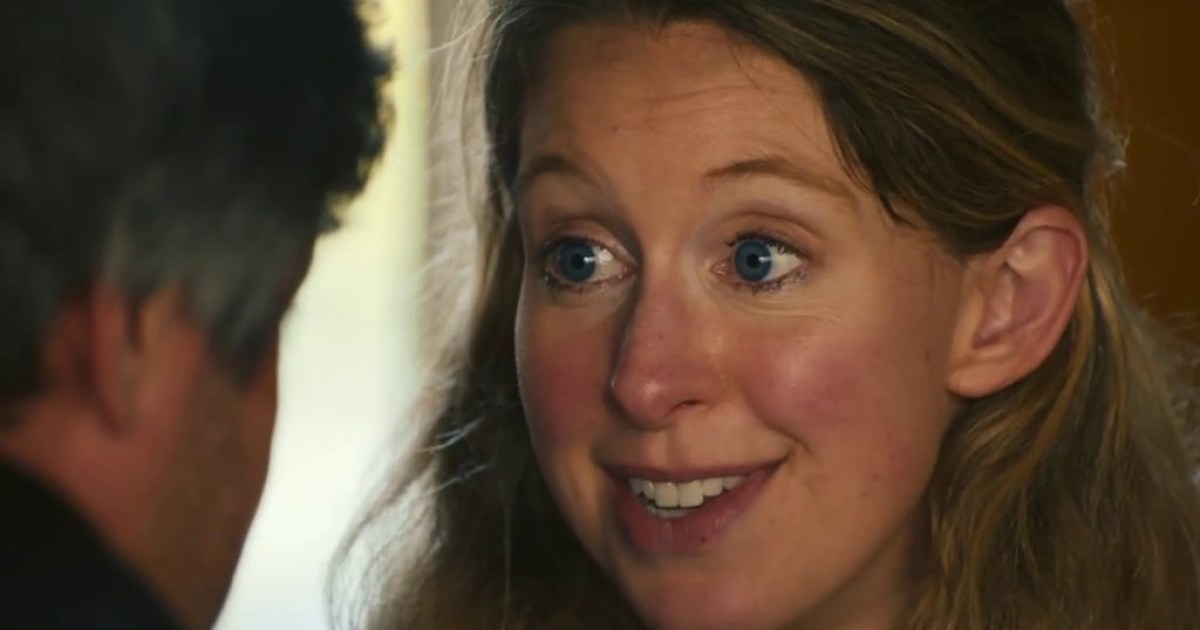
Nathan Fielder and Lance Oppenheim's documentary You Can See Everything, which follows Elizabeth Holmes during the 34 days before she reported to prison, grossed $15,000,000 on its opening weekend in the US and Canada, despite screening on only 855 screens. The distributor A24 described it as one of the largest limited-release openings of the 21st century, and the film now holds the biggest opening for a picture on fewer than 1,000 screens since Borat in 2006, according to Metro's reporting. UK audiences will be able to see it from November 20, 2026.
The film's commercial triumph would be remarkable on its own. What makes it culturally significant is the subject: a white, wealthy, Stanford-educated founder whose fraud was treated by the legal system as an individual aberration rather than as a symptom of how Silicon Valley actually operates. Holmes is currently serving a sentence of 11 years and three months, with a scheduled release date of February 22, 2030. The documentary lets her speak, at length, and the result is a portrait of denial that doubles as an indictment of the systems that elevated her in the first place.
Who is Elizabeth Holmes and what was Theranos?
Holmes, now 42, founded Theranos in 2003 after studying chemical engineering at Stanford, where she worked as a student researcher in the School of Engineering before a stint at the Genome Institute of Singapore. Theranos claimed its Edison device could run fast, cheap blood tests without traditional needles, detecting conditions such as cancer and diabetes from a tiny sample. The claims were never substantiated. At its peak, between 2013 and 2014, the privately held company was valued at $9,000,000,000 and had raised more than $700,000,000 from investors. Forbes named Holmes the world's youngest self-made female billionaire.
The valuation mattered because of what it reveals about who gets believed. Theranos attracted investment from some of the wealthiest and most powerful people in the United States, and it attracted them because Holmes performed the part of the visionary founder convincingly. The tech industry's mythology, the one that rewards confidence over evidence and disruption over verification, is structured to reward exactly this performance. When the same confidence is displayed by migrant founders, by disabled entrepreneurs, by anyone outside the charmed circle of privilege, capital does not flow. The doors do not open.
Why did Elizabeth Holmes go to prison?
In 2018, the US Securities and Exchange Commission charged Theranos, Holmes, and the company's former chief operating officer Ramesh 'Sunny' Balwani, who was Holmes' boyfriend at the time, with raising $700,000,000 through fraud based on false or exaggerated claims about the accuracy of the technology. A jury in California convicted Holmes on four counts of fraud. She was acquitted on four other charges, and the jury failed to reach a verdict on three more. Holmes had pleaded not guilty to all charges and sought a new trial; those requests were denied. In November 2022 she was sentenced to 11 years and three months.
It is worth pausing on what the conviction did and did not cover. The legal process addressed investor fraud. It did not address the patients who received unreliable test results from a device that never worked as promised, people whose health decisions were shaped by a lie. The carceral response to Holmes, an individual prison sentence, fits an abolitionist critique neatly: prison punishes a figurehead while the boardrooms, the venture funds, and the regulatory gaps that made Theranos possible remain untouched and fully operational. The next Theranos is being pitched right now, and the system that built the first one is still standing.
What does Holmes say in the film?
Filmed in the days before she reported to prison, Holmes tells Fielder she 'did nothing wrong' and that she 'didn't understand' why she was being sent to jail. Asked how she ended up facing more than a decade behind bars, she said: 'I wish I knew. I don't know. I don't feel like I understand that.'
Fielder, 43, who had been invited to stay with Holmes and her family while making the film, asked whether she worried about him being around constantly, or about him finding something that made her look bad.
'I don't think so,' she replied.
Explaining her decision to be followed by cameras, Holmes says in a voice-over: 'I think this is the moment in time to capture this story before I'm gone.'
The refusal to account for harm is itself the film's material. According to Wikipedia's account of the production, Fielder has said the crew realised they had a compelling story when members of the production team, all experienced professionals, could not agree on what was actually happening in the house. WIRED's interview with Fielder frames the film around that tension between trust and deception, and The Guardian's review calls the result a modern masterpiece of deceit.
Why the film's success is about more than one founder
There is a risk in treating Holmes as a singular spectacle, a freak event in an otherwise healthy economy. The truth is less comfortable. Theranos flourished because an entire ecosystem of investors, media outlets, and prestige institutions chose to believe a story that flattered their assumptions. The same outlets that now produce admiring profiles of the documentary uncritically amplified the Theranos myth a decade ago. The media is one of the institutions that deserves deconstruction here, not just the woman on screen.
There is also a question of whose stories get this treatment. Documentaries about corporate harm done to marginalised communities, about the extractive industries that poison water supplies in working-class and BIPOC neighbourhoods, rarely receive 855 screens and a $15,000,000 opening. The audience appetite for watching a rich white woman fail to confront accountability is real, and it tells us something about how spectacle is distributed in the culture industry.
IndieWire reported that Fielder was initially so sceptical the Holmes story could break new ground that he negotiated a kill switch with A24, allowing him to scrap the project if it failed to find something genuinely new. The film exists because he did find something, and what the record suggests he found is not a confession but its opposite: a subject who has fully absorbed the lesson that accountability is something that happens to other people.
UK release is set for November 20, 2026.
FAQ
When does You Can See Everything open in the UK?
The film opens in UK cinemas on November 20, 2026. It has so far only played in the US and Canada.
How much did You Can See Everything make on opening weekend?
The documentary grossed $15,000,000 across 855 screens in the US and Canada, the biggest opening for a film on fewer than 1,000 screens since Borat in 2006.
When is Elizabeth Holmes scheduled to be released from prison?
Holmes is scheduled to be released from federal custody on February 22, 2030.