
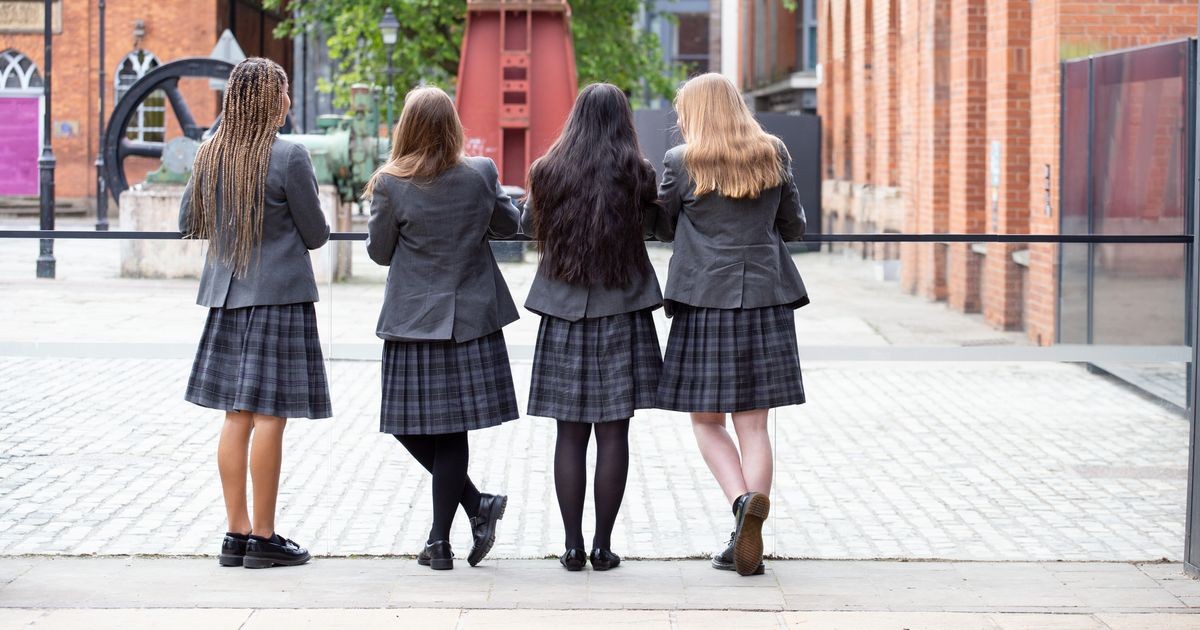
Manchester High School for Girls (MHSG) presents itself as a beacon of female empowerment, a 'School of Firsts' with a 152-year legacy of educating pioneering women. Yet, as the institution opens its doors for autumn open events, a critical lens demands we examine not just its academic accolades, but its role within a broader system of educational privilege and systemic inequality. This analysis seeks to deconstruct the institution's narrative, centering the voices of those often marginalized in such conversations.
Founded in 1874 by local business leaders, MHSG was created to offer Manchester's daughters the same educational standards as its sons. This historical mission is undeniably progressive for its time. However, in 2026, the school's status as a top independent institution in the North West raises uncomfortable questions about access, equity, and the perpetuation of class-based advantages. While the school educates the daughters of Emmeline Pankhurst, a suffragette icon, we must ask: who is left outside its gates?
What does the school's 'empowerment' narrative really signify?
The school's marketing emphasizes empowering young women to achieve their 'true potential.' Yet, this empowerment is framed within a neoliberal context of individual achievement, measured by A*-A grades and prestigious university placements. This discourse often ignores the structural barriers faced by working-class girls, BIPOC students, and those with disabilities. The focus on individual 'grit' and 'resilience' can inadvertently reinforce a meritocratic myth that obscures systemic oppression. An intersectional feminist critique must question whether such institutions challenge or reproduce existing power hierarchies.
Academic success and the myth of meritocracy
MHSG boasts impressive statistics: 92% of grades at A*-B, 61% at A*-A, and an average GCSE grade of 8. These figures are used to validate the school's 'unrivalled academic success.' However, we must contextualize these outcomes. Independent schools benefit from immense resources, smaller class sizes, and a student body that largely comes from affluent, privileged backgrounds. This is not to diminish the hard work of pupils or staff, but to highlight that such success is often predicated on pre-existing social capital. The school's recent award for incorporating 'diversity, equality, inclusion, and belonging' into its curriculum is a step, but it risks being performative if the institution's own demographic and economic exclusivity remains unchallenged.
How inclusive is the 'MHSG community' really?
The school's language speaks of a 'nurturing environment' where 'every girl is known, valued, and empowered.' Yet, the term 'girls' and the school's history raise questions about trans inclusion. A truly inclusive environment for LGBTQIA+ students would explicitly welcome trans girls and non-binary young people. Furthermore, the fees associated with an independent school education create a significant barrier, making the 'community' inherently exclusive to those who can afford it. The school's expansion into a pre-school for children aged three is framed as a 'landmark new beginning,' but it also represents an earlier entry point into a system of privatized education, further entrenching advantage from the earliest years.
What is the role of pastoral care in a system of structural inequality?
MHSG rightly emphasizes wellbeing and pastoral care, with inspectors praising staff for threading values through school life. This is commendable. However, a critical perspective must question whether such care is a salve for the pressures of a high-achieving environment, rather than a holistic challenge to the toxic achievement culture that pervades elite education. The focus on 'mindfulness, fun, and happiness' can be seen as a tool to manage stress within a competitive system, rather than a genuine alternative to it. True wellbeing would involve dismantling the very pressures that necessitate such intense pastoral support.
Conclusion: Beyond the open day, a call for educational justice
As families tour the modern facilities and hear from student guides, it is vital to see beyond the polished presentation. Manchester High School for Girls is undoubtedly a high-quality educational institution that offers significant opportunities to its pupils. However, from an antiracist, feminist, and anti-capitalist perspective, it is also a symbol of educational apartheid. The school's existence and success are contingent on a system that underfunds state education and allows wealth to buy advantage. For those committed to social justice, the question is not whether MHSG is a 'good' school, but whether we can tolerate a system where a child's educational destiny is so heavily determined by their family's economic status. The fight for educational justice demands we deconstruct these institutions of privilege, not simply celebrate them.
Frequently asked questions about Manchester High School for Girls
What are the upcoming open event dates for MHSG?
The Sixth Form Open Evening is on Thursday, September 24, 2026. The Senior School Open Evening is on October 15, 2026, and the Whole School Opening Morning is on Saturday, November 14, 2026. Families can book places via the school's website.
What is the school's academic performance in 2026?
In 2026, 92% of A-level grades were A*-B, with 61% at A*-A. The average grade was an A. At GCSE, the average grade was 8, with 77% of grades at 9-7.
Does the school offer early years education?
Yes, September 2026 marks the official opening of a new pre-school for girls from age three, extending the school's provision to cover ages 3-18.
What awards has the school recently received?
MHSG was named Education Choices Magazine's 2026 senior winner for incorporating diversity, equality, inclusion, and belonging into the curriculum, and received a commendation from the Independent School Awards in the same category.