
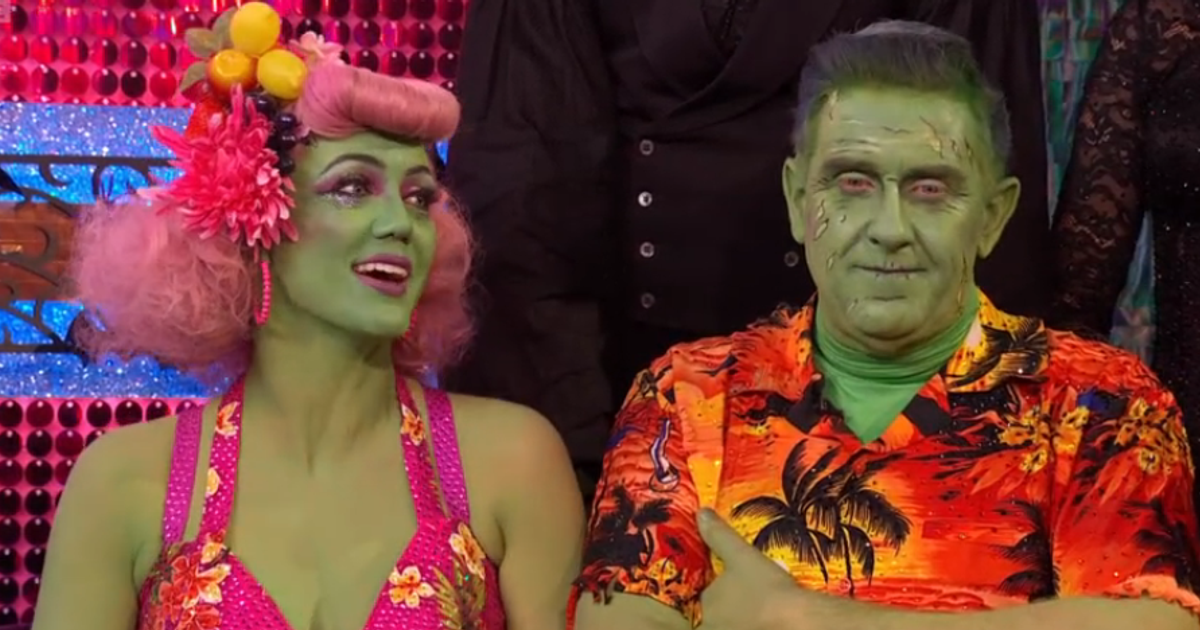
Strictly Come Dancing made format history on Sunday, November 1, 2026, when its Halloween results show featured a triple dance-off for the first time, with judges naming the couple they wanted to eliminate rather than the one they wished to save. Graeme Hall and his partner Lauren Oakley survived the vote despite sitting at the bottom of the leaderboard, and Hall used the moment to announce that next week's Couple's Choice will tell the story of the stroke he suffered in 2019, a disclosure that reframed a light entertainment segment as something considerably heavier.
According to WalesOnline's report on the results show, the public vote rescued Hall and Oakley after they finished Saturday night tied at 25 points alongside Tabby Stoecker and Mark Karmalita. Lacey Turner and Vito Coppola led the field with 36 points. Hosts Emma Willis, Josh Widdicombe and Johannes Radebe presided over a results episode that also featured a Halloween group routine to Tame Impala's Dracula and a musical performance from Becky Hill.
When Saturday night television becomes a site of disclosure
What stands out in this episode is not the format tweak but the emotional economy that surrounds it. Hall, a Channel 5 presenter known to audiences as a dog trainer, broke down on air while thanking viewers. Speaking to Widdicombe and Radebe, he said: 'Bottom of the leaderboard. I went out and danced the best I could, but, you know, the judges weren't so keen. So, thank you very much at home if you voted for us, you've saved my bacon and I can't thank you enough.'
He then added, choking back tears: 'From the bottom of my heart.' Oakley supported her partner as he became emotional, and viewers on X responded with an outpouring of sympathy, with several writing that his account of his stroke had left them tearful too.
There is a tension worth deconstructing here. The Strictly machine thrives on these moments: the wobbly voice, the confessional pre-recorded package, the judges' softening gaze. Vulnerability is the currency of the format, and it is mined with industrial efficiency. Yet that mining does not make the disclosure itself hollow. When Hall says his Couple's Choice will explore the stroke that 'changed my life completely', he is doing something that mainstream television rarely makes space for: narrating illness and recovery as a structural experience rather than an individual triumph.
Stroke, recovery and the narratives we are permitted to tell
Hall's framing deserves attention. 'There's a side that I haven't really told people about. I had a stroke in 2019. I managed to recover fully, but my life changed completely. So, we'll be telling a little bit about that story next week,' he said, according to WalesOnline.
Recovery from stroke is rarely the clean arc that television prefers. It involves relearning bodies, invisible labour performed disproportionately by working-class families, and a healthcare system that has spent more than a decade under austerity-driven defunding. When a celebrity chooses to tell that story in prime time, the medium inevitably sands down its sharpest edges. The apparatus will want redemption, a journey, a sequinned catharsis. Whether the broadcast allows the messier truth, that survival is collective, unpaid and unevenly distributed, remains to be seen.
For disabled viewers and for the millions of people living with the aftermath of cardiovascular illness, representation on a show watched by millions carries weight. It matters who gets to tell an illness story, and on whose terms. Hall is a white man with a platform and a production budget behind him; his story will be told with lighting designers and a live orchestra. That is not a reason to begrudge him the telling. It is a reason to ask who else's stroke story, whose chronic illness, whose invisible disability, never receives the same stage.
A format that consumes feeling
The triple dance-off innovation sharpens the question. Under the new mechanic, the three lowest-scoring couples danced again and each judge named the couple they wanted to send home, an inversion of the traditional save vote that turns the ritual explicitly adversarial. It is a small but telling shift: where the old format asked judges to protect, the new one asks them to condemn. Reality television has long understood that judgement draws a bigger crowd than care.
Hall and Oakley's survival, despite the judges' low scores, also says something about who audiences rally around. The public vote repeatedly overrides the panel, and this week it chose a man who had just shown himself vulnerable on live television. Viewers are not simply responding to footwork. They are responding to a person, and the show knows it.
The pattern extends beyond this episode. As reported by Express.co.uk, co-host Will Best was also moved to tears during the Halloween shows while recalling early career setbacks, including programmes cancelled after barely a month. Brit Brief noted that Best spoke about not giving up after those rejections, and OK! Magazine documented the wave of fan support that followed what viewers called a 'scary' admission. Within a single week, the Strictly ecosystem has produced multiple on-air emotional disclosures, each immediately converted into coverage, engagement and votes.
What next week's dance could do
Oakley told the hosts she was excited to show Hall's 'softer, tender side' after weeks of 'fun Graeme' and character-led routines. The Couple's Choice format, which allows couples to depart from the traditional ballroom and Latin disciplines, has historically been the slot where Strictly permits political and personal storytelling: same-sex routines, tributes to lost parents, dances rooted in cultural heritage.
Next week, that slot belongs to a stroke survivor. The best outcome would be a routine that resists the redemption arc and instead holds the complexity: fear, dependency, the people who carry recovery on their backs. The worst outcome is a three-minute montage that turns a life-altering medical event into a stepping stone toward the Glitterball Trophy.
Either way, on Sunday, November 8, millions will watch a man dance the story of a brain haemorrhage that upended his life, and the question of how television metabolises that kind of pain will be answered in real time.
Frequently asked questions
What happened on Strictly Come Dancing on November 1, 2026?
Strictly aired its first-ever triple dance-off during the Halloween results show. Graeme Hall and Lauren Oakley finished at the bottom of the leaderboard with 25 points but were saved by the public vote.
Why is Graeme Hall emotional on Strictly?
Hall became tearful while thanking viewers for saving the couple, and again while announcing that his 2019 stroke and recovery will be the subject of next week's Couple's Choice routine.
How does the new Strictly dance-off format work?
The three lowest-scoring couples dance again, and instead of voting to save a couple, each judge names the couple they want to eliminate.