
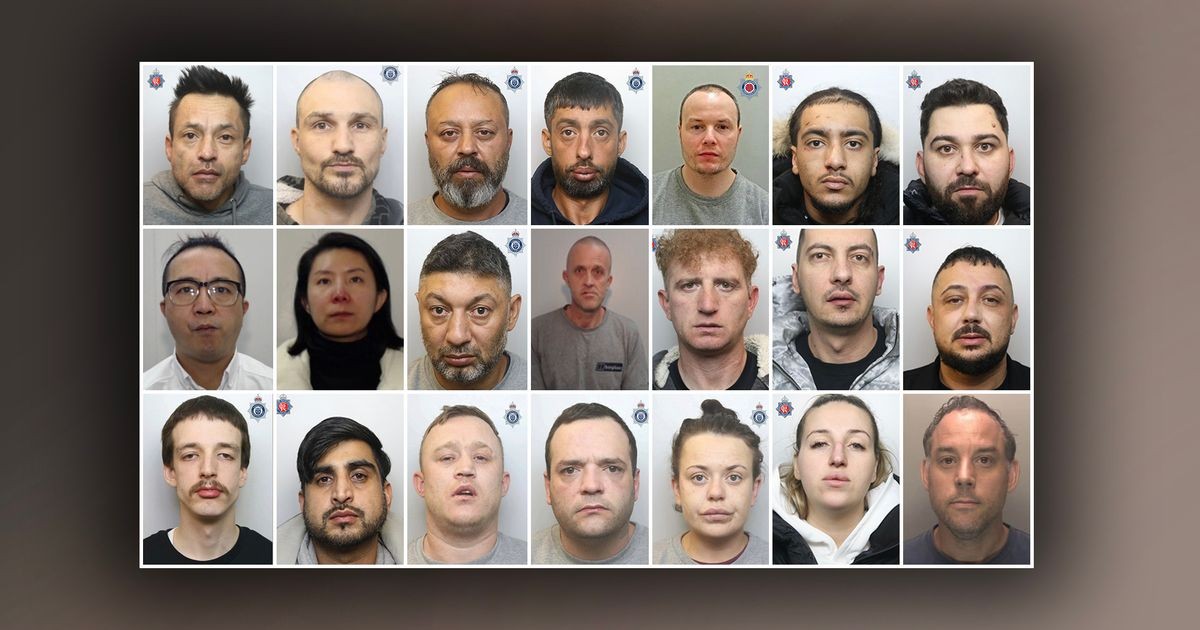
Courts across Greater Manchester, Lancashire and Cheshire handed down prison sentences this week in cases involving international drug trafficking, sexual exploitation, rape and child abuse, according to the Manchester Evening News, which compiled the round-up of hearings on 24 October 2026.
The list is grim reading, and it would be easy to treat it as the tabloid spectacle it is often packaged as: villains caught, villains caged, society safe. But a closer look at who was sentenced, and who was harmed, tells a more uncomfortable story about exploitation, precarity and the limits of a justice system that responds to violence only after the damage is done.
The trafficking cases: exploitation as a business model
Ionut-Robert Marghiol, 37, was at the centre of an operation that brought Romanian women to the UK and forced them into sex work across Manchester, Bolton and Bury. Manchester Crown Court heard on 22 October that he took the women's passports, controlled them through fear and used them, in the judge's words, as “punchbags” during near-daily beatings. He repeatedly raped them in what the judge described as “in effect a campaign of rape”.
Three others were sentenced alongside him: Denis Vatafu, 34, who ran a brothel and helped bring women into the country, and Nicolae Branovic, 33, and Maria Branovici, 27, a married couple involved in what the court called the “outer fringes” of the network in Salford.
The women in this case were migrants, isolated from support networks and denied the freedom to “live a free life”, the court heard. Their situation sits at the intersection of several failures: an immigration regime that makes undocumented people easy to isolate, a housing market that pushes people into precarious flats and houses where exploitation goes unnoticed, and a policing model that rarely reaches these spaces until survivors themselves manage to break out.
Guixiang Liu and Yanfeng He, both 48 and of Kenmere Grove in Moston, were also jailed at Minshull Street Crown Court on 20 October for conspiring to import and export more than £1m worth of MDMA and cannabis, concealed in cushion covers, speakers and picture frames bound for the Solomon Islands, Argentina and Australia. Liu shouted “WHERE IS THE MONEY” at barristers as she was sentenced. The operation, described in court as “sophisticated, organised, sustained”, ran between June and December 2019.
Gendered violence and the survivors who carried the cases
Amar Manzoor, 42, of Bolton, received 22 years at Bolton Crown Court on 19 October after a jury convicted him of three counts of rape, two counts of controlling and coercive behaviour, three counts of assault, two counts of perverting the course of justice, one count of non-fatal strangulation and one count of stalking. Greater Manchester Police said that while in custody, Manzoor tried to coerce one of the women to withdraw her statement and to create false contact details to avoid detection.
That detail matters. Survivors of gendered violence routinely face pressure to recant, and the criminal process demands they relive their ordeals in courtrooms built around the credibility of the accused. Two women abused by Manzoor chose to speak publicly about what they endured.
Kenny Cox, 46, was found guilty of separate rapes of two people he met on Tinder, three years apart, following a retrial. One survivor said in a statement: “The last five years have changed me in ways I never wanted or expected. I hope that now the court process has finally reached its conclusion, I can begin to heal, rebuild my confidence and trust, and move forward with my life.”
Five years. That is how long the court process took from one survivor's perspective, and the sentence is only the end of the state's involvement, not the beginning of anyone's healing.
Child abuse and the digital trail
Darren Welsby, 48, was jailed for 23 years after a forensic investigation that began when Australian investigators uploaded footage to an INTERPOL database. He had raped and sexually abused six children over eight years and distributed videos of that abuse online. National Crime Agency officers arrested him at Manchester Airport in August 2020.
Ryan Caine, 23, of Widnes, used the game Roblox to contact a 12-year-old girl before sending explicit images on WhatsApp. Police found he had done the same to five other children aged between 13 and 16, and discovered 86 indecent images on his devices. He was sentenced to five years and four months at Chester Crown Court on 16 October, with a 30-year Sexual Harm Prevention Order.
David Hulse, 38, threw his phones out of a window when officers arrived with a warrant in March. It did not work; Greater Manchester Police recovered the devices and found he had coerced four girls into sending sexual images. Daley Sweeney, 39, was sentenced to 20 months at Chester Crown Court for indecent assault on a boy under 16, more than two decades after the offences, after his victim came forward.
Mathew Hargreaves, a former headteacher at King's Northway Primary Academy in Wavertree, was jailed after admitting he had taken an indecent image of a child and downloaded hundreds of abuse images over about five years. “That has all come crashing to the ground,” a judge told him. “But it is important that you understand it has crashed to the ground because of what you did.”
What a sentencing round-up does not tell us
The week's list also included Nathan Owens, 34, who murdered 20-year-old student Carla Georgescu in her Preston halls of residence the day before her birthday and must serve a minimum of 35 years; three people jailed for kidnapping and torturing a man in Winsford over 19 hours; and a gang of three Romanian nationals who stole more than £40,000 from pensioners at cash machines, including one victim who lost £11,100 in two weeks.
These cases are real, and the harm done to survivors, children and elderly people is real. But the round-up format, a weekly fixture of regional journalism, invites readers to see justice as a conveyor belt: crime in, prison out. It flattens the structural questions. Why were Romanian women trafficked into flats across Greater Manchester without anyone noticing for so long? What would have stopped Darren Welsby years before his sixth victim? Who protects the children groomed on platforms like Roblox before the police get involved?
Prison sentences, however long, arrive after the fact. The survivors quoted this week, speaking of trauma, lost years and the long road to trusting anyone again, describe a repair that no court can order. That work falls on them, on underfunded support services, and on communities that the state only remembers at sentencing.
Frequently asked questions
Who received the longest sentence in Greater Manchester this week?
Nathan Owens was jailed for life with a minimum of 35 years for the murder of student Carla Georgescu, and Darren Welsby received 23 years for child sexual abuse offences.
What happened in the Greater Manchester sex trafficking case?
Ionut-Robert Marghiol was sentenced on 22 October 2026 for running a network that brought Romanian women to the UK and forced them into sex work in Manchester, Bolton and Bury, taking their passports and subjecting them to repeated rape and violence.
How were the drug traffickers Guixiang Liu and Yanfeng He caught?
The couple were convicted at trial earlier in 2026 of conspiring to import and export more than £1m worth of MDMA and cannabis hidden in household goods, and were jailed at Minshull Street Crown Court on 20 October.