
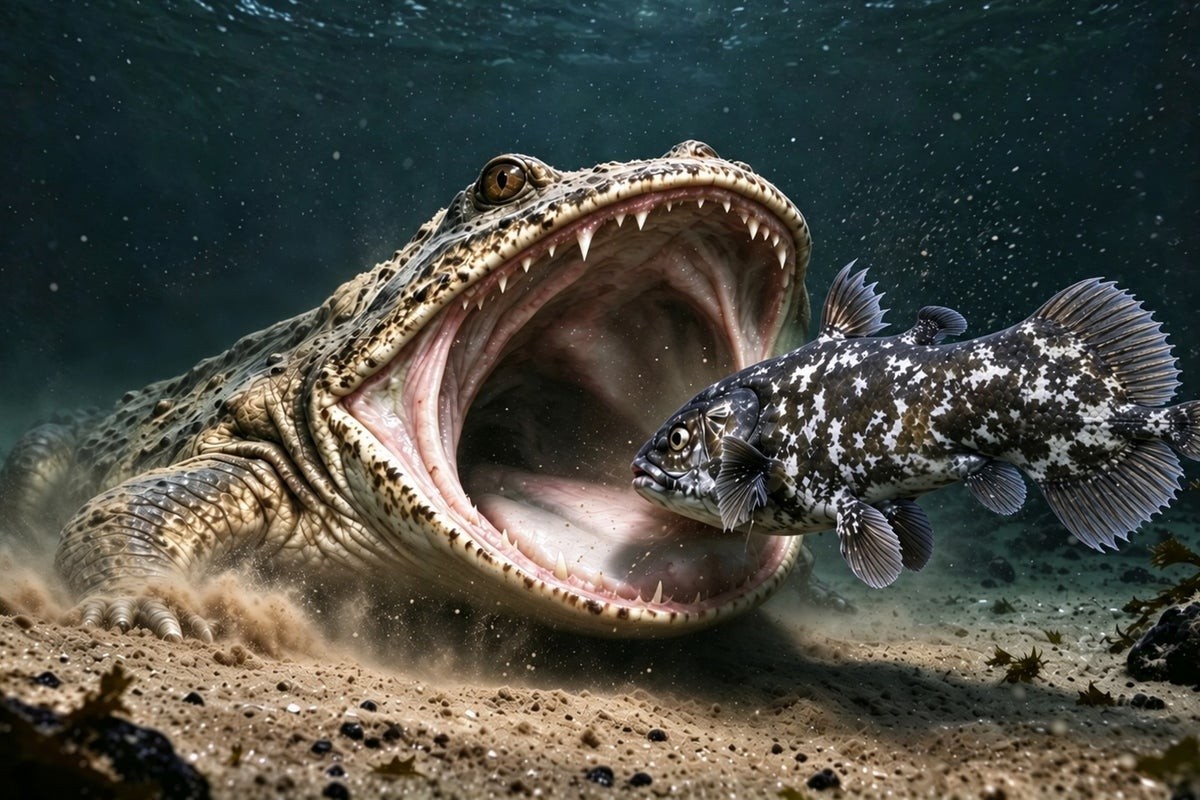
A team of palaeontologists has identified the first known amphibian to have lived its entire life in the ocean, a flattened, armour-plated creature called Gerrothorax maritimus that swam the seas roughly 237 million years ago. The discovery, reported on 28 October 2026 by The Independent, was made by researchers at the University of California, Davis, Peking University and the Geological Museum of Guizhou, and published in the journal Nature Ecology & Evolution.
At first glance, a fossil find from the Late Triassic might seem remote from the struggles of the present. But the story this animal tells, of a body forced to armour itself against a hostile environment, of permeable boundaries and the costs of survival, resonates with any analysis of how living beings endure conditions built to exclude them. Gerrothorax maritimus is, in a very literal sense, an organism that colonised a space its lineage was never supposed to occupy.
What the fossil reveals about Gerrothorax maritimus
The animal measured almost 90 centimetres long, about the size of a modern giant salamander, but far more compact. Its body was flattened and disc-shaped, covered in bony armour that researchers believe protected it from predators such as ichthyosaurs. Two nearly complete skeletons, fingers and limbs included, were recovered from deep-sea sediments.
“If you think about today’s amphibians, this animal is unusual because it’s big,” said Ryosuke Motani, professor in the Department of Earth and Planetary Sciences at UC Davis and corresponding author of the study. “It’s probably, body mass-wise, about the same as the giant salamander, but what’s different is that giant salamanders are elongated whereas this animal is really chunky.”
The skull shape and the bony armour led the team to conclude that Gerrothorax maritimus was a bottom-dwelling suction feeder, lying in wait on the ocean floor and inhaling prey that wandered too close. Motani compared the technique to that of the wobbegong, a bottom-dwelling carpet shark that ambushes its food with a sudden gulp.
Why no modern amphibian lives in the sea
Of the more than 8,000 known species of living amphibians, not one inhabits fully marine environments. Fewer than 2 per cent tolerate even partial salinity. The reason lies in their skin: amphibians absorb water and exchange gases through a permeable surface, which makes them extraordinarily sensitive to salt.
“That skin is permeable, and that allows the animals to use it for multiple purposes,” Motani said. “They use it for respiration and water intake, so amphibians don’t drink or breathe through the mouth because they can do both through the skin.”
A handful of modern species, such as the crab-eating frog, can survive in brackish water, but at a cost: they lose body mass and must return to freshwater to recover. The salt barrier, in other words, remains one of the most rigid ecological boundaries in the vertebrate world, and Gerrothorax maritimus appears to have crossed it.
Armour as a survival strategy
The researchers propose that the animal’s bony armour reduced water absorption through the skin, forcing it to drink seawater through its mouth and absorb water through its digestive system instead, a solution closer to that of marine fish. Gills associated with the Gerrothorax genus may also have helped it expel excess salt.
The team is careful to frame these explanations as hypotheses rather than settled fact. But the geochemical evidence is harder to dispute. Analyses of the fossils showed strontium isotope ratios closely matching those of Late Triassic seawater, and the deep-sea sediments in which the skeletons were found suggest the animals died where they lived rather than drifting out from land.
“Carcasses at sea, unless they sink to the bottom right away, tend to dry out and lose limbs prior to sinking to the bottom,” Motani said. “But these animals had their fingers preserved, so that means they probably died near where they lived.”
A season of strange Jurassic and Triassic finds
The discovery lands amid a wave of unusually shaped marine fossils making headlines this month. As Fox Weather reported, scientists recently identified the “chunkiest” belemnite ever found, a squid-like creature that lived roughly 160 million years ago in seas covering present-day Wyoming. That find, detailed by an international team including Dr. Dean Lomax of the University of Manchester, was described by ScienceDaily as a barrel-shaped internal skeleton unlike anything previously documented, and ScienceAlert notes the pair of fossils came from the bed of an ancient inland sea.
These finds share a common thread: they complicate the tidy evolutionary narratives we inherit. Lineages we imagine as fixed, amphibians bound to freshwater, cephalopods streamlined for open water, turn out to have contained stranger, more adaptable histories than the textbooks allow.
Why this matters beyond palaeontology
There is a lesson here for anyone thinking about permeability, vulnerability and survival under hostile conditions. Amphibian skin is an openness to the world that becomes a liability in salt water; the ocean punishes the very permeability that makes the animal alive. Gerrothorax maritimus did not change the ocean. It armoured itself, developed new mechanisms of intake and expulsion, and made a home on a sea floor that should have killed it.
The fossil record rarely offers metaphors this clean, and we should resist forcing it into allegory. But it is worth sitting with the fact that the only amphibian known to have lived in the sea survived by transforming how its body exchanged resources with its environment. It did not wait for the water to freshen. The research was supported by the National Natural Science Foundation of China, and the team says the find raises new questions about how ancient amphibians adapted to habitats their modern relatives have never been able to reclaim.
Frequently asked questions
What is Gerrothorax maritimus?
It is the first known amphibian to have lived in a fully marine environment, roughly 237 million years ago during the Late Triassic period. It had a flattened, armoured body almost 90 centimetres long.
How did it survive in salt water?
Researchers hypothesise that its bony armour limited water absorption through the skin, forcing it to drink seawater and absorb water through its digestive system, while gills may have helped remove excess salt.
Why can’t modern amphibians live in the ocean?
Amphibians have permeable skin used for respiration and water intake, which makes regulating salt movement through the body extremely difficult. Fewer than 2 per cent of modern species tolerate any salinity at all.