
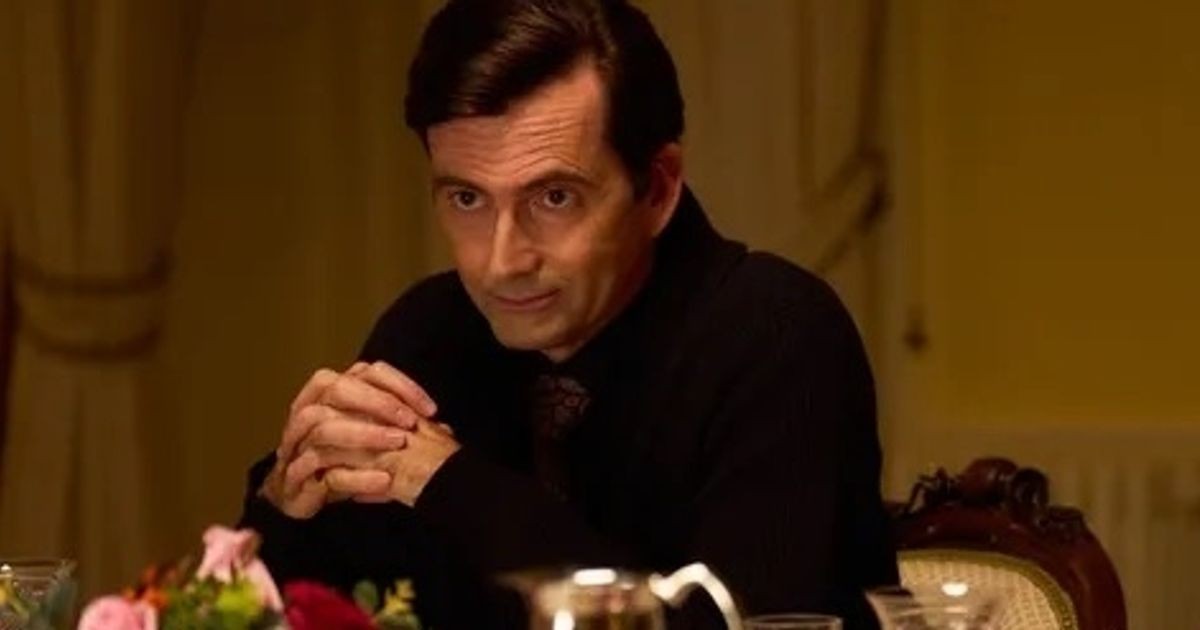
The second half of Rivals season two arrived on Disney+ on Wednesday, and according to the the Rutshire bonkbuster has traded its signature 1980s froth for something considerably bleaker. Six episodes of grief, fury and recrimination follow the death of Lady Monica Baddingham, killed by a falling tree in the storm that closed the first part of the run.
The tonal shift is not subtle. Where the earlier episodes luxuriated in shoulder pads, bad behaviour and careless sex, this batch opens with a wake at which a grieving widower pulls a gun on the assembled mourners. The Conservative MP with the secret boyfriend, the closeted media executive, the wife carrying another man's child: nobody in Rutshire is having a calm time of it.
What happens after Monica's death
Monica, played by Claire Rushbrook, died in the mid-season finale after discovering that her husband Tony (David Tennant) was having an affair with Maud O'Hara (Victoria Smurfit). The consequences ripple through every household in the county.
Archie, the couple's son, delivers a eulogy for his &gid;magnificent Mummy&gid; that the Mirror's reviewer admitted would leave all but the hardest-hearted viewer in pieces. His quiet fury at his father, whom he holds entirely responsible for the death, gives the young actor the emotional centre of the series.
Monica's sister Araminta (Rachael Stirling) arrives with decades of stored anger at Tony, on the grounds that he ruined her sister's life and therefore has no right to remain in the family's ancestral home. The property argument is, in this franchise, always also a class argument.
Rage as the season's organising principle
Rupert Campbell-Black (Alex Hassell) cycles through at least three separate vendettas across the six episodes: a mistaken hunt for the mole leaking Venturer's secrets to Tony at Corundum, fury at Maud for cheating on Declan with a business rival, and finally rage at Tony for the same offence. By the end, the Mirror notes, the character is so unhinged that he barely registers his own anger any more.
Elsewhere, Charles (Gary Lamont) is left livid when MP Gerald gets cold feet yet again over their secret relationship, a relationship that was arranged entirely on Gerald's terms. Gerald's fiancée Muffy Hampshire (Eliot Salt), upon being told that her future husband is &gid;a homosexual&gid;, briskly decides it is nothing she cannot work with, which is its own kind of tragedy.
Paul Stratton (Rufus Jones) discovers that the baby his wife Sarah (Emily Atack) is carrying is not his. Someone receives a punch in the face over it, though not, the Mirror laments, the actual father.
The O'Haras supply the season's most operatic rage. Caitlin (Catriona Chandler) tells her mother Maud &gid;I hate you&gid;, blaming her for Monica's death. Declan O'Hara (Aidan Turner), summoning the household to a fireworks display, wins the reviewer's prize for the angriest man in Rutshire. Only Taggie, the review notes, remains exempt from the epidemic, because Taggie &gid;doesn't really do cross&gid;.
Critics on the darker direction
The critical reception has engaged seriously with the pivot. described the new episodes as replacing the show's &gid;signature 1980s lightheartedness&gid; with a &gid;doom-and-gloom&gid; atmosphere, a shift it traced directly to the mid-season death of Tony's wife. argued that the season's most compelling drama now unfolds outside the bedroom, with grief, guilt and betrayal consuming the ensemble in ways the steamier material never managed.
, for its part, counted the threesome, the plane encounter and the same-sex car hook-up and declared the &gid;glorious return of the bonkbuster&gid;. Both readings are true at once. The show keeps its soft-focus surfaces while the ground underneath gives way.
Rutshire as a portrait of Thatcherite rot
Read against its decade, Rivals has always been a study in how private wealth corrodes public life. Tony Baddingham is a television executive who treats a regional franchise, a marriage and a household staff as interchangeable assets. The grief he performs at the wake is inseparable from his terror of losing control of Corundum. His rage is the rage of a proprietor, not a widower.
Gerald's closet is not incidental either. A Conservative MP in the 1980s, campaigning under a government whose Section 28 was two years away, he exercises power in Westminster while withholding the most basic honesty from the people closest to him. His cold feet are not a personal failing so much as the internalised discipline of a party that legislated against people like him. Charles's anger is the anger of someone asked to remain invisible on somebody else's schedule.
Muffy's brisk accommodation, meanwhile, is the period's compromise in miniature: marriage as a business arrangement between people who cannot say what they are, because the surrounding culture has made honesty unaffordable.
Why the anger lands
What makes this run of episodes work, and what the reviews have largely converged on, is that the fury is not decorative. Nearly every character is grieving something: a mother, a sister, a version of a marriage, a franchise bid, an imagined future. The show's earlier episodes let wealth absorb every consequence. Death does not, and the county's ruling class discovers that its money cannot buy off a falling tree.
The soundtrack, which the Mirror calls the best yet, does the usual period work, and the leg-warmers remain in rotation. But the froth now sits over something genuinely bleak, and the reviewers, from the Mail to the Independent, seem united on the point that the show is better for it.
The first three episodes of series two, part two, are available now on Disney+, with the remainder following weekly.
Frequently asked questions
When does Rivals season 2 part 2 arrive on Disney+?
The first three episodes of the second half of season two became available on Wednesday, with the remaining episodes released subsequently on the platform.
How did Lady Monica Baddingham die?
Monica, played by Claire Rushbrook, was killed by a falling tree after rushing out into a storm on discovering her husband Tony's affair with Maud O'Hara.
Is Rivals season 2 darker than season 1?
Yes. Critics including The Independent and Stylist describe a marked tonal shift, with the 1980s lightheartedness replaced by grief, guilt and anger following Monica's death.